


Page 137 - (DK Eyewitness) Travel Guide - Ireland
P. 137
SOUTHEAST IRELAND 135
importance of horses in Irish life.
Exhibits include the frail skele-
ton of Arkle, a famous champion
steeple chaser in the 1960s.
Sharing the same estate as
the National Stud are the
Japanese Gardens and
St Fiachra’s Garden. The
Japanese Gardens were laid
out in 1906–10 by Japanese
landscape gardener Tassa Eida,
with the help of his son
Minoru and 40 assistants. The
impressive array of trees and
shrubs includes maple, bonsai,
mulberry, magnolia, sacred
bamboo and cherry. The
gardens take the form of an
allegorical journey through life,
beginning with the Gate of
Oblivion and leading to the
Gateway of Eternity, a con-
templative Zen rock garden.
St Fiachra’s Garden covers
1.6 ha (4 acres) of woodland,
wet land, lakes and islands,
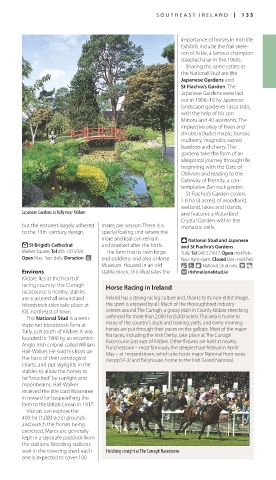
Japanese Gardens at Tully near Kildare and features a Waterford
Crystal Garden within the
but the restorers largely adhered mares per season. There is a monastic cells.
to the 13th-century design. special foaling unit where the
mare and foal can remain Y National Stud and Japanese
R St Brigid’s Cathedral undisturbed after the birth. and St Fiachra’s Gardens
Market Square. Tel 085 120 5920. The farm has its own forge Tully. Tel 045 521617. Open mid-Feb–
Open May–Sep: daily. Donation. 7 and saddlery, and also a Horse Nov: 9am–6pm. Closed Dec–mid-Feb.
Museum. Housed in an old & 7 8 National Stud only. - =
Environs stable block, this illustrates the ∑ irishnationalstud.ie
Kildare lies at the heart of
racing country: the Curragh Horse Racing in Ireland
racecourse is nearby, stables
are scattered all around and Ireland has a strong racing culture and, thanks to its non-elitist image,
bloodstock sales take place at the sport is enjoyed by all. Much of the thoroughbred industry
Kill, northeast of town. centres around The Curragh, a grassy plain in County Kildare stretching
The National Stud is a semi- unfenced for more than 2,000 ha (5,000 acres). This area is home to
state-run bloodstock farm at many of the country’s studs and training yards, and every morning
Tully, just south of Kildare. It was horses are put through their paces on the gallops. Most of the major
founded in 1900 by an eccentric flat races, including the Irish Derby, take place at The Curragh
Racecourse just east of Kildare. Other fixtures are held at nearby
Anglo-Irish colonel called William Punchestown – most famously the steeplechase festival in April/
Hall-Walker. He sold his foals on May – at Leopardstown, which also hosts major National Hunt races
the basis of their astrological (see pp32–3) and Fairyhouse, home to the Irish Grand National.
charts, and put skylights in the
stables to allow the horses to
be “touched” by sunlight and
moon beams. Hall-Walker
re ceived the title Lord Wavertree
in reward for bequeathing the
farm to the British Crown in 1917.
Visitors can explore the
400-ha (1,000-acre) grounds
and watch the horses being
exercised. Mares are generally
kept in a separate paddock from
the stallions. Breeding stallions
wait in the covering shed: each Finishing straight at The Curragh Racecourse
one is expected to cover 100
134-135_EW_Ireland.indd 135 08/03/17 11:06 am

