


Page 138 - (DK Eyewitness) Travel Guide - Ireland
P. 138
136 IRELAND REGION B Y REGION
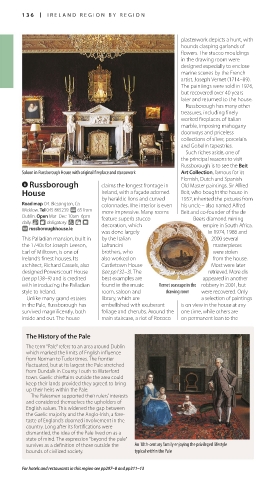
plasterwork depicts a hunt, with
hounds clasping garlands of
flowers. The stucco mouldings
in the drawing room were
designed especially to enclose
marine scenes by the French
artist, Joseph Vernet (1714–89).
The paintings were sold in 1926,
but recovered over 40 years
later and returned to the house.
Russborough has many other
treasures, including finely
worked fireplaces of Italian
marble, imposing mahogany
doorways and priceless
collections of silver, porcelain
and Gobelin tapestries.
Such riches aside, one of
the principal reasons to visit
Russ borough is to see the Beit
Saloon in Russborough House with original fireplace and stuccowork Art Collection, famous for its
Flemish, Dutch and Spanish
6 Russborough claims the longest frontage in Old Master paintings. Sir Alfred
House Ireland, with a façade adorned Beit, who bought the house in
by heraldic lions and curved 1952, inherited the pictures from
Road map D4. Blessington, Co colonnades. The interior is even his uncle – also named Alfred
Wicklow. Tel 045 865239. @ 65 from more impressive. Many rooms Beit and co-founder of the de
Dublin. Open Mar–Dec: 10am–6pm feature superb stucco Beers diamond mining
daily. & 8 obligatory. 7 = - dec oration, which empire in South Africa.
∑ russboroughhouse.ie
was done largely In 1974, 1986 and
This Palladian mansion, built in by the Italian 2000 several
the 1740s for Joseph Leeson, Lafrancini master pieces
Earl of Milltown, is one of brothers, who were stolen
Ireland’s finest houses. Its also worked on from the house.
architect, Richard Cassels, also Castle town House Most were later
designed Powerscourt House (see pp132–3). The retrieved. More dis-
(see pp138–9) and is credited best examples are appeared in another
with introducing the Palladian found in the music Vernet seascape in the robbery in 2001, but
style to Ireland. room, saloon and drawing room were recovered. Only
Unlike many grand estates library, which are a selection of paintings
in the Pale, Russborough has embellished with exuberant is on view in the house at any
survived magnificently, both foliage and cherubs. Around the one time, while others are
inside and out. The house main staircase, a riot of Rococo on permanent loan to the
The History of the Pale
The term “Pale” refers to an area around Dublin
which marked the limits of English influence
from Norman to Tudor times. The frontier
fluctuated, but at its largest the Pale stretched
from Dundalk in County Louth to Waterford
town. Gaelic chieftains outside the area could
keep their lands provided they agreed to bring
up their heirs within the Pale.
The Palesmen supported their rulers’ interests
and considered themselves the upholders of
English values. This widened the gap between
the Gaelic majority and the Anglo-Irish, a fore-
taste of England’s doomed involvement in the
country. Long after its fortifications were
dismantled, the idea of the Pale lived on as a
state of mind. The expression “beyond the pale”
survives as a definition of those outside the An 18th-century family enjoying the privileged lifestyle
bounds of civilized society. typical within the Pale
For hotels and restaurants in this region see pp297–8 and pp311–13
136-137_EW_Ireland.indd 136 08/03/17 11:06 am
Eyewitness Travel LAYERS PRINTED:
Catalogue template “UK” LAYER
(Source v2)
Date 14th November 2012
Size 125mm x 217mm

