


Page 216 - (DK Eyewitness) Travel Guide - Ireland
P. 216
214 IRELAND REGION B Y REGION
t Galway
Galway is both the centre for the Irish-speaking regions in the
West and a lively university city. Under the Anglo-Normans,
it flourished as a trading post. In 1396 it gained a Royal
Charter and, for the next two centuries, was controlled by
14 merchant families, or “tribes”. The city prospered under
English influence, but this allegiance to the Crown cost
Galway dear when, in 1652, Cromwell’s forces wreaked havoc.
After the Battle of the Boyne (see p248), Galway fell into
decline, unable to compete with east-coast trade. However,
the city’s profile has been revived as a developing centre for
high-tech industry.
Inside The Quays seafood restaurant and pub
pace provides plenty of
opportunity to stop off at its “Latin Quarter”. On the corner
shops, pubs and historic sights. of Abbeygate Street Upper
and Shop Street stands
Eyre Square Lynch’s Castle, now a bank, but
The redeveloped square still the grandest 16th-century
encloses a pleasant plaza and town house in Galway. It was
park lined with imposing, owned by the Lynch family,
mainly 19th-century, buildings. one of the 14 “tribes”.
On the northwest of the square A side street leads to the
is the Browne Doorway, a Collegiate Church of St
17th-century entrance from a Nicholas, Galway’s finest med-
mansion in Abbeygate Street ieval building. The church,
Lower. Beside it is a fountain founded in 1320, was extended
adorned with a sculpture in the 15th and 16th centuries,
Houses on the banks of the Corrib of a Galway hooker boat. The but then damaged by the
Eyre Square Centre, over looking Cromwellians, who used it to
Exploring Galway the park, is a modern shopping stable horses. The west porch
The centre of the city lies on the mall built to incor porate is from the 15th century and
banks of the River Corrib, which sections of the historic city there are some finely carved
flows down from Lough Corrib walls. Walkways link Shoemakers gargoyles under the parapet.
(see p213) widening out as it and Penrice towers, two of the Quay Street is lined with
reaches Galway Bay. Urban 14 wall towers that used to ring restaurants and pubs, including
renewal since the 1970s has led the city in the 17th century. The Quays (see p329). Tígh
to extensive restoration of the Neachtain is a town house
narrow, winding streets of this Latin Quarter which belonged to “Humanity
once-walled city. Due to its From Eyre Square, William Street Dick”, an 18th-century MP who
compact size, Galway is easy to and Shop Street are the main promoted laws against cruelty
explore on foot, and a leisurely routes into the bustling to animals. Today, it too is a
restaurant and pub (see p330).
Nearby are the Taibhdhearc and
Druid theatres (see p338).
North Galway
The Cathedral of St Nicholas
(1965), built of local limestone
and Connemara marble, stands
on the west bank. From here
you can see Wood Quay, where
Lough Corrib cruises start in the
summer (see p213). National
University of Ireland Galway,
further west, is a large campus
with a 1849 Gothic Revival
quad. Salmon Weir Bridge links
the two banks. Shoals of salmon
rest under the bridge on their
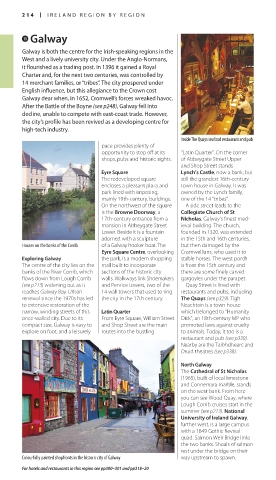
Colourfully painted shopfronts in the historic city of Galway way upstream to spawn.
For hotels and restaurants in this region see pp300–301 and pp318–20
214-215_EW_Ireland.indd 214 25/04/16 10:42 am

