


Page 261 - (DK Eyewitness) Travel Guide - Ireland
P. 261
IRELAND REGION B Y REGION 259
NORTHERN
IRELAND
Londonderry • Antrim • Tyrone • Fermanagh
Armagh • Down
Northern Ireland has sights from every era of Ireland’s history as
well as magnificently varied coastal and lakeland scenery. During the years of
the “Troubles”, it received fewer visitors than the Republic, however, now that
there is a movement towards peace it is attracting the attention it deserves.
The area constituted as Northern Ireland and Scottish Protestants (see p43). Many
was created after partition of the island Plantation towns, such as London derry,
in 1921. Its six counties (plus Donegal, preserve their 17th-century layout around
Monaghan and Cavan) are part of Ulster, a central square or “diamond”. The arrival of
one of Ireland’s four trad itional kingdoms. new settlers meant that Irish Catholics
It was most probably in Ulster that were increas ingly marginalized, thereby
Christianity first ousted the old Celtic sowing the seeds of 400 years of conflict.
pagan beliefs. In 432 St Patrick landed In the relative tranquillity of the 18th
at Saul in County Down, later found ing century, the Anglo-Irish nobility built stately
a church at Armagh, which is still the homes, such as Mount Stewart House on
spiritual capital of Ireland. the Ards Peninsula and Castle Coole near
The dominant political force in early Enniskillen. Ulster also enjoyed prosperity in
Christian times was the Uí Néill clan. Their the 19th century through its linen, rope-
descendants, the O’Neills, put up fierce making and ship-building industries.
resistance to English con quest in the late Though densely populated and
16th century. Hugh O’Neill, Earl of Tyrone, industrialized around Belfast, away from
had some notable successes against the the capital the region is pri marily agri-
armies of Elizabeth I, but was defeated cultural. It also has areas of outstanding
and in 1607 fled to Europe with other natural beauty, notably the rugged
Irish lords from Ulster, in what became Antrim coastline around the Giant’s
known as the “Flight of the Earls”. Causeway, the Mountains of
Vacant estates were granted to Mourne in County Down and
individu als and companies, who the Fermanagh lakelands in
planted them with English the southwest.
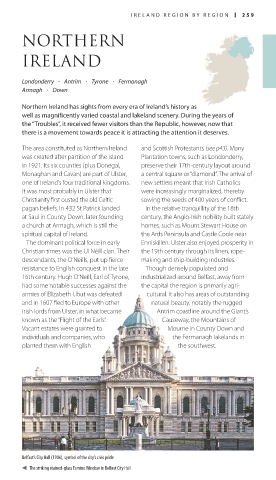
Belfast’s City Hall (1906), symbol of the city’s civic pride
The striking stained-glass Famine Window in Belfast City Hall
258-259_EW_Ireland.indd 259 08/03/17 11:08 am

