


Page 258 - (DK Eyewitness) Travel Guide - Ireland
P. 258
256 IRELAND REGION B Y REGION
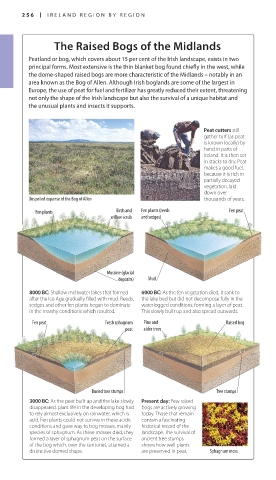
The Raised Bogs of the Midlands
Peatland or bog, which covers about 15 per cent of the Irish landscape, exists in two
principal forms. Most extensive is the thin blanket bog found chiefly in the west, while
the dome-shaped raised bogs are more characteristic of the Midlands – notably in an
area known as the Bog of Allen. Although Irish boglands are some of the largest in
Europe, the use of peat for fuel and fertilizer has greatly reduced their extent, threatening
not only the shape of the Irish landscape but also the survival of a unique habitat and
the unusual plants and insects it supports.
Peat cutters still
gather turf (as peat
is known locally) by
hand in parts of
Ireland. It is then set
in stacks to dry. Peat
makes a good fuel,
because it is rich in
partially decayed
vegetation, laid
down over
Unspoiled expanse of the Bog of Allen thousands of years.
Fen plants Birch and Fen plants (reeds Fen peat
willow scrub and sedges)
Moraine (glacial
deposits) Mud
8000 BC: Shallow meltwater lakes that formed 6000 BC: As the fen vegetation died, it sank to
after the Ice Age gradually filled with mud. Reeds, the lake bed but did not decompose fully in the
sedges and other fen plants began to dominate waterlogged conditions, forming a layer of peat.
in the marshy conditions which resulted. This slowly built up and also spread outwards.
Fen peat Fresh sphagnum Pine and Raised bog
peat alder trees
Buried tree stumps Tree stumps
3000 BC: As the peat built up and the lake slowly Present day: Few raised
disappeared, plant life in the developing bog had bogs are actively growing
to rely almost exclusively on rainwater, which is today. Those that remain
acid. Fen plants could not survive in these acidic contain a fascinating
conditions and gave way to bog mosses, mainly historical record of the
species of sphagnum. As these mosses died, they landscape. The survival of
formed a layer of sphagnum peat on the surface ancient tree stumps
of the bog which, over the centuries, attained a shows how well plants
distinctive domed shape. are preserved in peat. Sphagnum moss
256-257_EW_Ireland.indd 256 08/03/17 11:07 am
Eyewitness Travel LAYERS PRINTED:
Catalogue template “UK” LAYER
(Source v2)
Date 14th November 2012
Size 125mm x 217mm

