


Page 32 - (DK Eyewitness) Travel Guide - Ireland
P. 32
30 INTRODUCING IRELAND
Ireland’s Celtic Heritage
Ireland’s rich tradition of storytelling embraces a folk
heritage that abounds with myths and superstitions. Some
stories have been in written form since the 8th century, but
most originated over 2,000 years ago when druids passed
on stories orally from one generation to the next. Like the
Gaelic language itself, many of Ireland’s legends have links
with those of ancient Celtic races throughout Europe. As
well as the heroic deeds and fearless warriors of mythology, The formidable Queen Maeve
Irish folklore is also rich in tales of fairies, leprechauns, of Connaught
banshees and other supernatural beings. revenge on Cúchulainn by
using sor cerers to lure him to
his death. Today, in Dublin’s GPO
(see p93), a statue of Cúchulainn
commemorates the heroes of
the 1916 Easter Rising.
Finn McCool
The warrior Finn McCool is
the most famous leader of
the Fianna, an elite band of
troops chosen for their strength
and valour and who defended
Ireland from foreign forces.
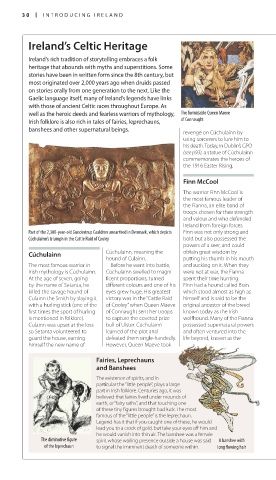
Part of the 2,300-year-old Gundestrup Cauldron unearthed in Denmark, which depicts Finn was not only strong and
Cúchulainn’s triumph in the Cattle Raid of Cooley bold but also possessed the
powers of a seer, and could
Cúchulainn Cúchulainn, meaning the obtain great wisdom by
hound of Culainn. putting his thumb in his mouth
The most famous warrior in Before he went into battle, and sucking on it. When they
Irish mythology is Cúchu lainn. Cúchulainn swelled to magni were not at war, the Fianna
At the age of seven, going ficent proportions, turned spent their time hunting.
by the name of Setanta, he different colours and one of his Finn had a hound called Bran
killed the savage hound of eyes grew huge. His greatest which stood almost as high as
Culainn the Smith by slaying it victory was in the “Cattle Raid himself and is said to be the
with a hurling stick (one of the of Cooley” when Queen Maeve original ancestor of the breed
first times the sport of hurling of Connaught sent her troops known today as the Irish
is mentioned in folk lore). to capture the coveted prize wolfhound. Many of the Fianna
Culainn was upset at the loss bull of Ulster. Cúchulainn possessed supernatural powers
so Setanta volun teered to learned of the plot and and often ventured into the
guard the house, earning defeated them singlehandedly. life beyond, known as the
himself the new name of However, Queen Maeve took
Fairies, Leprechauns
and Banshees
The existence of spirits, and in
particular the “little people”, plays a large
part in Irish folklore. Centuries ago, it was
believed that fairies lived under mounds of
earth, or “fairy raths”, and that touching one
of these tiny figures brought bad luck. The most
famous of the “little people” is the leprechaun.
Legend has it that if you caught one of these, he would
lead you to a crock of gold, but take your eyes off him and
he would vanish into thin air. The banshee was a female
The diminutive figure spirit whose wailing presence outside a house was said A banshee with
of the leprechaun to signal the imminent death of someone within. long flowing hair
030-031_EW_Ireland.indd 30 08/03/17 11:05 am
Eyewitness Travel LAYERS PRINTED:
Feature template “UK” LAYER
(SourceReport v1.1)
Date 3rd August 2012
Size 125mm x 217mm

