


Page 27 - (DK Eyewitness) Travel Guide - Ireland
P. 27
A POR TR AIT OF IRELAND 25
Iron Age Forts Tower Houses
1 Staigue Fort p169 w Aughnanure Castle p213
2 Dún Aonghasa p216 e Thoor Ballylee pp218–19
3 Craggaunowen p194 r Knappogue Castle p193
4 Grianán Ailigh pp230–31 t Blarney Castle p175
5 Hill of Tara p252 y Donegal Castle p234
Round Tower Georgian Country
Houses
6 Kilmacduagh p218
7 Ardmore p149 u Strokestown Park House pp222–3
8 Clonmacnoise pp254–5 i Castle Coole p276
9 Devenish Island p275 o Emo Court p257
0 Kilkenny p148 p Russborough House pp136–7 The well-preserved round
q Glendalough pp144–5 a Castletown House pp132–3 tower at Ardmore
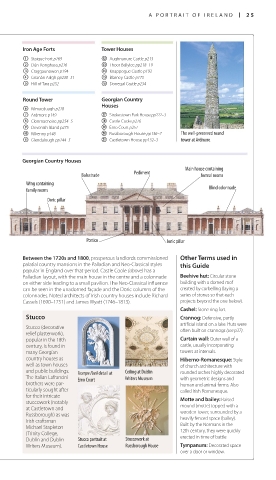
Georgian Country Houses
Main house containing
Balustrade Pediment formal rooms
Wing containing
family rooms Blind colonnade
Doric pillar
Portico Ionic pillar
Between the 1720s and 1800, prosperous landlords commissioned Other Terms used in
Spiral palatial country mansions in the Palladian and NeoClassical styles this Guide
staircase popular in England over that period. Castle Coole (above) has a
Palladian layout, with the main house in the centre and a colonnade Beehive hut: Circular stone
on either side leading to a small pavilion. The NeoClassical influence building with a domed roof
can be seen in the unadorned façade and the Doric columns of the created by corbelling (laying a
colonnades. Noted architects of Irish country houses include Richard series of stones so that each
Cassels (1690–1751) and James Wyatt (1746–1813). projects beyond the one below).
Cashel: Stone ring fort.
Stucco Crannog: Defensive, partly
artificial island on a lake. Huts were
Stucco (decorative often built on crannogs (see p37).
relief plasterwork),
popular in the 18th Curtain wall: Outer wall of a
century, is found in castle, usually incorporating
many Georgian towers at intervals.
country houses as Hiberno-Romanesque: Style
well as town houses of church architecture with
and public buildings. Trompe l’oeil detail at Ceiling at Dublin rounded arches highly deco rated
The Italian Lafrancini Emo Court Writers Museum with geometric designs and
brothers were par human and animal forms. Also
ticularly sought after called IrishRomanesque.
for their intricate Motte and bailey: Raised
stuccowork (notably mound (motte) topped with a
at Castletown and wooden tower, surrounded by a
Russborough) as was heavily fenced space (bailey).
Irish craftsman Built by the Normans in the
Michael Stapleton 12th century, they were quickly
(Trinity College, erected in time of battle.
Dublin and Dublin Stucco portrait at Stuccowork at
Writers Museum). Castletown House Russborough House Tympanum: Decorated space
over a door or window.
024-025_EW_Ireland.indd 25 25/04/16 11:00 am

