


Page 67 - (DK Eyewitness) Travel Guide - Ireland
P. 67
SOUTHEAST DUBLIN 65
6 St Ann’s Church
Dawson St. Map E4. Tel 676 7727.
Open 10am–4pm Mon–Fri (also for Sun
service at 11:15am).
St Ann’s, founded in 1707, has a
striking Romanesque façade,
which was added in 1868. Inside
are colourful stained-glass
win dows, dating from the mid-
19th century. The church has a
long tradi tion of charity work: in
1723 Lord Newton left a be quest
to buy bread for the poor. The
original shelf for the bread still
stands next to the altar.
Famous past parishioners
include Wolfe Tone (see p45),
who was married here in 1785,
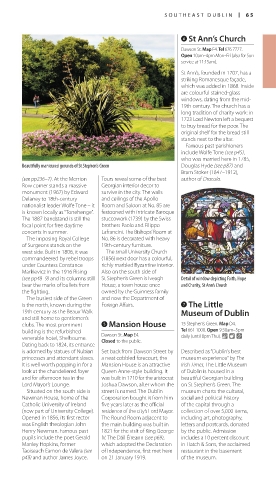
Beautifully manicured grounds of St Stephen’s Green Douglas Hyde (see p87) and
Bram Stoker (1847–1912),
(see pp236–7). At the Merrion Tours reveal some of the best author of Dracula.
Row corner stands a massive Georgian interior decor to
monument (1967) by Edward survive in the city. The walls
Delaney to 18th-century and ceilings of the Apollo
nationalist leader Wolfe Tone – it Room and Saloon at No. 85 are
is known locally as “Tonehenge”. festooned with intricate Baroque
The 1887 bandstand is still the stucco work (1739) by the Swiss
focal point for free daytime brothers Paolo and Filippo
concerts in summer. Lafrancini. The Bishops’ Room at
The imposing Royal College No. 86 is decorated with heavy
of Surgeons stands on the 19th-century furniture.
west side. Built in 1806, it was The small University Church
commandeered by rebel troops (1856) next door has a colourful,
under Countess Constance richly marbled Byzantine interior.
Markievicz in the 1916 Rising Also on the south side of
(see pp48–9) and its columns still St Stephen’s Green is Iveagh Detail of window depicting Faith, Hope
bear the marks of bullets from House, a town house once and Charity, St Ann’s Church
the fighting. owned by the Guinness family
The busiest side of the Green and now the Depar t ment of
is the north, known during the Foreign Affairs. 7 The Little
19th century as the Beaux’ Walk Museum of Dublin
and still home to gentlemen’s
clubs. The most prominent 5 Mansion House 15 Stephen’s Green. Map D4.
building is the refurbished Dawson St. Map E4. Tel 661 1000. Open 9:30am–5pm
venerable hotel, Shelbourne. Closed to the public. daily (until 8pm Thu). & 8 0
Dating back to 1824, its entrance
is adorned by statues of Nubian Set back from Dawson Street by Described as “Dublin’s best
princesses and attendant slaves. a neat cobbled forecourt, the museum experience” by The
It is well worth popping in for a Mansion House is an attractive Irish Times, The Little Museum
look at the chandeliered foyer Queen Anne-style building. It of Dublin is housed in a
and for afternoon tea in the was built in 1710 for the aristocrat beautiful Georgian building
Lord Mayor’s Lounge. Joshua Dawson, after whom the on St Stephen’s Green. The
Situated on the south side is street is named. The Dublin museum charts the cultural,
Newman House, home of the Corpor ation bought it from him social and political history
Catholic University of Ireland five years later as the official of the capital through a
(now part of University College). residence of the city’s Lord Mayor. collection of over 5,000 items,
Opened in 1856, its first rector The Round Room adjacent to including art, photo graphy,
was English theo logian John the main building was built in letters and postcards, donated
Henry Newman. Famous past 1821 for the visit of King George by the public. Admission
pupils include the poet Gerald IV. The Dáil Éireann (see p69), includes a 10 percent discount
Manley Hopkins, former which adopted the Declaration in Hatch & Sons, the acclaimed
Taoiseach Eamon de Valera (see of Independence, first met here restaurant in the basement
p49) and author James Joyce. on 21 January 1919. of the museum.
064-065_EW_Ireland.indd 65 08/03/17 11:05 am

