


Page 8 - (DK Eyewitness) Travel Guide - Ireland
P. 8
6 HOW T O USE THIS GUIDE
HOW TO USE THIS GUIDE
This guide helps you to get the most from descriptions of all the important sights,
your visit to Ireland. It provides both expert with maps, pictures and illustrations.
recommendations and detailed practical Restaurant and hotel recommendations
information. Introducing Ireland maps can be found in Travellers’ Needs. The
the country and sets it in its historical Survival Guide has tips on everything from
and cultural context. The seven regional the telephone system to transport both in
chapters, plus Dublin Area by Area, contain the Republic and in Northern Ireland.
Dublin Area by Area DUBLIN AREA B Y AREA 77
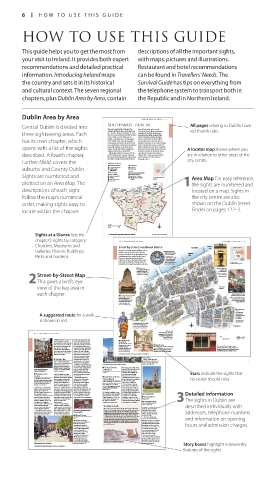
Central Dublin is divided into SOUTHWEST DUBLIN All pages relating to Dublin have
The area around Dublin Castle was first
these old city walls can be seen at
three sightseeing areas. Each settled in prehistoric times, and it was from St Audoen’s Church. More conspicuous red thumb tabs.
reminders of the Anglo-Normans are
here that the city grew. Dublin gets its name
from the dark pool (Dubh Linn) which formed provided by the grand medieval Christ
at the confluence of the Liffey and the Church Cathedral and Ireland’s largest
has its own chapter, which Poddle, a river which once ran through the church, Saint Patrick’s Cathedral. When
site of Dublin Castle. It is now channelled
the city expanded to the north and east
during the Georgian era, the narrow cobbled
underground and trickles out into the Liffey
by Grattan Bridge. Archaeological excavations streets of Temple Bar became a quarter of
opens with a list of the sights behind Wood Quay, on the banks of the skilled craftsmen and merchants. Today this A locator map shows where you
lively area of town bustles with tourists, and
Liffey, reveal that the Vikings established a
trading settlement here around 841. is home to a variety of “alternative” shops
Following Strongbow’s invasion of 1170, a
described. A fourth chapter, medieval city began to emerge; the Anglo- and cafés. The Powerscourt Centre, an are in relation to other areas of the
elegant 18th-century mansion, has been
Normans built strong defen sive walls around
converted into one of the city’s best
Further Afield, covers the the castle. A small reconstructed section of shopping centres. city centre.
Sights at a Glance
Museums and Libraries Historic Streets
suburbs and County Dublin. 2 Chester Beatty Library 5 Temple Bar
6 Wood Quay
8 Dublinia and the
Viking World
w Marsh’s Library Churches
7 Christ Church Cathedral pp84–5
Sights are numbered and Historic Buildings 9 St Audoen’s Church See also Street Finder map
1 Dublin Castle pp80–81
q Saint Patrick’s Cathedral
3 City Hall
e Whitefriar Street Carmelite
4 Powerscourt Centre Church pp122–3 Area Map For easy reference,
plotted on an Area Map. The 0 Tailors’ Hall Millennium Ha'penny Bridge 1the sights are numbered and
W E L L ING T O N Q U AY
Grattan
descriptions of each sight Father Mathew Rossa Bridge WOOD QUAY L i f f e y ESSEX QUAY Bridge PARLIAMENT ST ESSEX STREET EAST Bridge MEETING- HOUSE EUSTACE ST TEMPLE BAR TEMPLE LA SOUTH TEMPLE ST SQUARE COPE ST BAR ASDILL'S ROW ANGLESEA S
O'Donovan
Bridge
MERCHANT’S QUAY
FOWNES
CROW ST
ESSEX ST WEST
follow the map’s numerical BRIDGE ST BRIDGE ST LOWER COOK STREE T STREET WINETAVERN FISHAMBLE ST EXCHANGE ST LOWER CRANE LA SQUARE DAME D A M E S T R E E T the city centre are also
LORD EDWARD ST
LANE
BORRIS ST MICHAEL’S CLOSE ST AN DREW’S ST
UPPER
CT ST MICHAEL ’ S HILL CHRISTCHURCH PL CASTLE STRE E T
order, making sights easy to LAMB B A C K ALLEY L A N E WERBURGH ST SHIP ST CASTLE STEPS SOUTH GREAT GEORGE’S ST EXCHEQUER ST MARKET CASTLE WICKLOW ST shown on the Dublin Street
HIGH STREET
locate within the chapter. JOHN DILLON STREET NI CH O L A S ST R E E T ROSS ROAD LITTLE CHANCERY LA SHIP STREET GREAT FADE ST DRURY STREET WILLIAM ST SOUTH CLARENDON CLARENDON STREET Finder on pages 122–3.
BRIDE ROAD
DIGGES LANE
AUNGIER STREET
LONGFORD
ST GREAT
BULL ALLEY STREET GOLDEN WHITEF RIAR ST LANE STEPHEN ST UPPER STEPHEN ST LOWER ROW
PATRICK S TREET PARK B R I D E S T R E E T WOOD ST BOW LANE EAST
ST PATRICK'S
0 metres 250 ST PATRICK’S CLOSE P E TER STREE T YORK STREET
0 yards 250 KEVIN STREET UPPER
Sights at a Glance lists the A stunning stained-glass window in Christ Church Cathedral For map symbols see back flap
chapter’s sights by category: 78 DUBLIN AREA B Y AREA SOUTHWEST DUBLIN 79
Churches, Museums and Street-by-Street: Southwest Dublin Ha’penny Bridge O’Connell NORTH OF THE LIFFEY
Galleries, Historic Buildings, Despite its wealth of ancient buildings, such as Sunlight Chambers Bridge
Dublin Castle and Christ Church Cathedral,
were built in 1900 for
Parks and Gardens. this part of Dublin lacks the sleek appeal of the the Lever Brothers Millennium SOUTHWEST
Bridge
company. The
neighbouring streets around Grafton Street.
DUBLIN
delightful terracotta
However, redevelopment has helped to
decoration on the
rejuvenate the area, especially around Temple façade advertises SOUTHEEST
DUBLIN
Bar, where the attractive cobbled streets are their main business of Locator Map
lined with interesting shops, galleries and cafés. soap manufacturing. See Street Finder map pp122–3
6 Wood Quay L I F F E Y T E M P L E B A R C R O W N A L L E Y 5. Temple Bar
This is where the Vikings W E L L I N G T O N Q U AY This arts and
established their first F O W N E S S T entertainments
permanent settlement
Street-by-Street Map in Ireland around 841. district occupies a
maze of nar row,
cobbled streets.
2This gives a bird’s-eye E S S E X Q U AY E S S E X S T E A S T E U S TA C E S T R E E T T E M P L E L A N E
view of the key area in PA R L I A M E N T S T R E E T C R A N E L A N E S Y C A M O R E S T D A M E S T R E E T Central Bank
of Ireland
each chapter. 7. Christ Church Cathedral F I S H A M B L E S T E S S E X S T W E S T between Drury Street and
George’s Street Arcade
Huge family monuments D A M E S T R E E T South Great George’s Street is
including that of the a popular spot for buying
19th Earl of Kildare can be second-hand clothes and
found in Ireland’s oldest D A M E C T antique jewellery.
cath edral, which also
L O R D E D W A R D S T S T H G T G E O R G E ’ S S T E X C H E Q U E R S T 4 Powerscourt
has a fascinating crypt.
This shopping
A suggested route for a walk C H R I S T C H U R C H P L C A S T L E S T W I L L I A M S T S O U T H Centre
centre is one
of the best places
in Dublin to
is shown in red. find fashion
acces sories and
arts and crafts.
St Werburgh’s Church, built D R U R Y S T
in the 18th-century, has an To Grafton Street
ornate interior hiding behind
its somewhat drab exterior.
3 City Hall
Originally built as the Royal
82 DUBLIN AREA B Y AREA SOUTHWEST DUBLIN 83 Exchange in 1779, the city’s
muni cipal headquarters is Key 0 metres 50
fronted by a huge
1960s turned it into a centre of premises to young artists and 8 Dublinia and the bustling market and the inside Corinthian portico. Suggested route 0 yards 50
specialist galleries, antique to record, clothing and book Viking World of a merchant’s kitchen.
shops, jewellery stalls, cafés and shops. The area developed an Medieval Dublin and the Major events in Dublin’s
other shop units. The enclosed “alternative” identity, and when Vikings are the subjects history, such as the Black Death
1. Dublin Castle
central courtyard, topped by a the development plans were of this interactive and the rebellion of Silken The Long Hall is a magnificent, old-
The Drawing Room, with its Waterford
glass dome, is a popular scrapped the artists and retailers museum, located in the Thomas (p42) are also crystal chandelier, is part of a suite of fashioned pub with a great atmosphere.
meeting place with Dubliners. stayed on. Described by some former Synod Hall of portrayed here as well as a Behind the narrow room’s long bar stands
luxurious rooms built in the 18th
The centre can also be reached cynics as the city’s “officially the Church of Ireland. largescale model of Dublin
a bewildering array of antique clocks.
century for the Viceroys of Ireland.
from Grafton Street down the designated arts zone”, Temple For hotels and restaurants in this region see pp296–7 and pp308–11
circa 1500. An interactive
Johnson Court alley. Bar today is an exciting place archaeology room highlights
with bars, restaurants, shops excavations at nearby Wood
and several galleries. Stylish Quay (see p82).
5 Temple Bar residential and commercial The 60m (200ft) high St
development is contributing 078-079_EW_Ireland.indd All Pages Michael’s Tower offers one of 11/01/2016 12:52
Map C3. Temple Bar Information further to the area’s appeal. the best vantage points for
Tel 677 2255. See also Entertainment in
Dublin p118. Project Arts Centre: Highlights include the Project Former Synod Hall, now home to the Dublinia exhibition views across the city.
39 East Essex Street. Tel 881 9613. Arts Centre, a highly respected
Irish Film Institute: 6 Eustace Street. venue for avantgarde perform 7 Christ Church NeoGothic Synod Hall, which,
Central courtyard of Powerscourt Tel 679 5744. _ Diversions, (May– ance art; and the Irish Film Cathedral up until 1983, was home to the
Townhouse Shopping Centre Sep). ∑ templebar.ie Institute, which shows art See pp84–5. ruling body of the Church Stars indicate the sights that
house and inde pen dent films,
of Ireland. The building and
4 Powerscourt Some of Dublin’s best night and has a popular restaurant/ the humpbacked bridge
Centre spots, restaurants and unusual bar and shop. 8 Dublinia and the linking it to Christ Church
shops line these narrow, cobbled Nearby Meeting House
Cathedral date from the 1870s.
South William St. Map D4. Tel 679 streets running between the Square is one of the venues Viking World Before Dublinia was established no visitor should miss.
4144. Open 10am–6pm Mon–Fri (8pm Bank of Ireland (see p64) and for Diversions, a summer in 1993, the Synod Hall
Thu), 9am–6pm Sat, noon–6pm Sun. Christ Church Cathedral. In programme of free outdoor St Michael’s Hill. Map B3. Tel 679 4611. was used as a nightclub.
See also Shopping in Ireland pp332–3. the 18th century the area was concerts, theatre and film Open Mar–Sep: 10am–5pm; Oct–Feb: The exhibition is entirely
∑ powerscourtcentre.ie home to many insalubrious screenings. The National 10am–4:30pm. Closed 17 Mar & interactive, encouraging the
23–26 Dec. & charge to enter Christ
Completed in 1774 by Robert characters – Fownes Street was Photographic Archive and Church Cathedral via bridge. 7 visitor to become an investi
Mack, this grand mansion was noted for its brothels. It was also Gallery of Photography are also ∑ dublinia.ie gator of Dublin’s past. Visitors
built as the city home of the birthplace of parliamentarian on the square and there is an enter via the basement where
Viscount Powerscourt, who also Henry Grattan (see p44). Skilled excellent organic food market The Dublinia exhibition covers the Viking World exhibition tells
had a country estate at craftsmen and artisans, such as here on Saturdays, where you the formative period of Dublin’s the story of the notorious Tower of St Audoen’s Church Detailed Information
Enniskerry (see pp138–9). Granite clockmakers and printers, lived can sample oysters, salmon, history from the arrival of the Scandianavian settlers. The 9 St Audoen’s
from the Powerscourt estate and worked around Temple Bar cheese and other local produce. AngloNormans in 1170 to the exhibition continues on the
was used in its construc tion. until postwar industrialization closure of the monasteries in ground floor, where a medieval Church 3The sights in Dublin are
Today the building houses one led to a decline in the the 1540s (see p42). The city is depicted through lifesize High St, Cornmarket. Map B3.
of Dublin’s best shopping area’s fortunes. exhibition is housed in the recon structions including a Tel 677 0088. Open May–Oct
centres. Inside it still features the In the 1970s, the CIE (the 9:30am–5:30pm. 8
original grand mahogany national transport authority) The Vikings in Dublin described individually with
staircase, and detailed plaster bought up parcels of land in this Designated a national monu
work by Michael Stapleton. area to build a major bus depot. Viking raiders arrived in Ireland in the late 8th century and founded ment and open for visitors
The building became a drap Before building, the CIE rented The Temple Bar pub, established in 1840, Dublin in 841. They built a fort where the River Poddle met the Liffey throughout the summer
at a black pool (Dubh Linn), on the site of Dublin Castle. They also
ery warehouse in the 1830s, and out, on cheap leases, some of located on Temple Bar established a settlement along the banks of the Liffey at Wood Quay months, St Audoen’s is the addresses, telephone numbers
major restoration during the the old retail and warehouse (see p82). Much of their trade was based on silver, slaves and piracy. earliest surviving medieval
6 Wood Quay church in Dublin.
Following their defeat by Brian Ború at the Battle of Clontarf in 1014
Map B3. (see p38), the Vikings integrated fully with the local Irish, adopting The 15thcentury nave and information on opening
remains intact and the three
Christian beliefs. After Strongbow’s AngloNorman invasion in 1170
Named after the timber (see p40), the flourishing HibernoViking trading community declined, bells date from 1423. The church
supports used to reclaim the and many were banished to a separate colony called Oxmanstown, stands in an attractive church
land, Wood Quay has just north of the river. yard with wellmaintained lawns
undergone excavations and shrubs. To the rear of the hours and admission charges.
revealing the remains of one churchyard, steps lead down to
of the earliest Viking villages St Audoen’s Arch, the only
in Ireland (see p83). The remaining gateway of the old
excavated area opened to city. Flanking the gate are
public view in 2008. restored sections of the
Valuable and informative 13thcentury city walls.
Viking artifacts that were Next door stands St Audoen’s
discovered can be seen Roman Catholic Church, which
at the Dublinia exhibition was built in the 1840s. The two
(see p83) and at the National Artist’s impression of a Viking ship in Dublin Bay Pacific clam shells by the front
Strolling through the streets of Temple Bar Museum (see pp70–71). door hold holy water. Story boxes highlight note worthy
For hotels and restaurants in this region see pp296–303 and pp308–25
features of the sights.
006-007_EW_Ireland.indd 6 08/03/17 11:04 am

