


Page 88 - (DK Eyewitness) Travel Guide - Ireland
P. 88
86 DUBLIN AREA B Y AREA
0 Tailors’ Hall
Back Lane. Map B4. Tel 707 7076.
Open Mon–Fri by appointment only.
∑ antaisce.org
Dublin’s only surviving guild hall
preserves a delightful corner of
old Dublin in an otherwise busy
redevelop ment zone. Built in
1706, it stands behind a lime
stone arch in a quiet cobbled
yard. The build ing is the oldest
guildhall in Ireland and was used
by various trade groups including
hosiers, saddlers and barber
surgeons as well as tailors. It also
hosted political meetings –
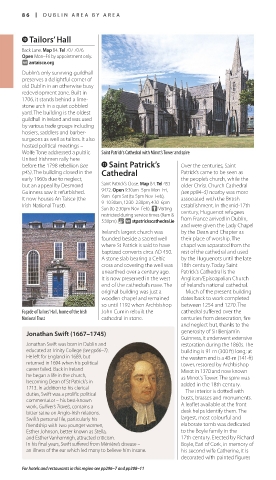
Wolfe Tone addressed a public Saint Patrick’s Cathedral with Minot’s Tower and spire
United Irishmen rally here
before the 1798 rebellion (see q Saint Patrick’s Over the centuries, Saint
p45). The building closed in the Cathedral Patrick’s came to be seen as
early 1960s due to neglect, the people’s church, while the
but an appeal by Desmond Saint Patrick’s Close. Map B4. Tel 453 older Christ Church Cathedral
Guinness saw it refurbished. 9472. Open 9:30am–5pm Mon–Fri, (see pp84–5) nearby was more
9am–6pm Sat (to 5pm Nov–Feb),
It now houses An Taisce (the 9–10:30am, 12:30–2:30pm, 4:30–6pm associated with the British
Irish National Trust). establishment. In the mid17th
Sun (to 2:30pm Nov–Feb). 5 Visiting
restricted during service times (9am & century, Huguenot refugees
5:30pm). & ∑ stpatrickscathedral.ie from France arrived in Dublin,
and were given the Lady Chapel
Ireland’s largest church was by the Dean and Chapter as
founded beside a sacred well their place of wor ship. The
where St Patrick is said to have chapel was separated from the
baptized converts circa AD 450. rest of the cathedral and used
A stone slab bearing a Celtic by the Huguenots until the late
cross and covering the well was 18th century. Today Saint
un earthed over a century ago. Patrick’s Cathedral is the
It is now preserved in the west Anglican/Episcopalian Church
end of the cathedral’s nave. The of Ireland’s national cathedral.
original building was just a Much of the present building
wooden chapel and remained dates back to work completed
so until 1192 when Archbishop between 1254 and 1270. The
Façade of Tailors’ Hall, home of the Irish John Cumin rebuilt the cathedral suffered over the
National Trust cathedral in stone. centuries from desecration, fire
and neglect but, thanks to the
Jonathan Swift (1667–1745) generosity of Sir Benjamin
Guinness, it underwent exten sive
Jonathan Swift was born in Dublin and restoration during the 1860s. The
educated at Trinity College (see pp66–7). building is 91 m (300 ft) long; at
He left for England in 1689, but the western end is a 43m (141ft)
returned in 1694 when his political tower, restored by Archbishop
career failed. Back in Ireland Minot in 1370 and now known
he began a life in the church, as Minot’s Tower. The spire was
becoming Dean of St Patrick’s in added in the 18th century.
1713. In addition to his clerical The interior is dotted with
duties, Swift was a prolific political
commentator – his bestknown busts, brasses and monuments.
work, Gulliver’s Travels, contains a A leaflet available at the front
bitter satire on AngloIrish relations. desk helps identify them. The
Swift’s personal life, particularly his largest, most colourful and
friendship with two younger women, elaborate tomb was dedicated
Esther Johnson, better known as Stella, to the Boyle family in the
and Esther Vanhomrigh, attracted criticism. 17th century. Erected by Richard
In his final years, Swift suffered from Ménière’s disease – Boyle, Earl of Cork, in memory of
an illness of the ear which led many to believe him insane. his second wife Catherine, it is
decorated with painted figures
For hotels and restaurants in this region see pp296–7 and pp308–11
086-087_EW_Ireland.indd 86 08/03/17 11:05 am
Eyewitness Travel LAYERS PRINTED:
Catalogue template “UK” LAYER
(Source v2)
Date 14th November 2012
Size 125mm x 217mm

