


Page 85 - (DK Eyewitness) Travel Guide - Ireland
P. 85
SOUTHWEST DUBLIN 83
experience. Major events in
Dublin’s history, such as the
Black Death and the rebellion
of Silken Thomas (p42) are
also portrayed here, and there
is a large-scale model of Dublin
circa 1500. An interactive
archaeology room highlights
excavations at nearby Wood
Quay (see p82).
The 60-m (200-ft) high
St Michael’s Tower (with
96 steps) offers one of the
best vantage points for views
across the city.
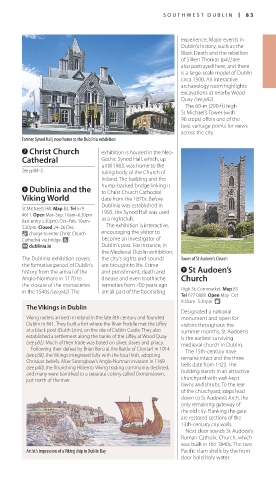
Former Synod Hall, now home to the Dublinia exhibition
7 Christ Church exhibition is housed in the Neo-
Cathedral Gothic Synod Hall, which, up
until 1983, was home to the
See pp84–5. ruling body of the Church of
Ireland. The building and the
8 Dublinia and the hump-backed bridge linking it
to Christ Church Cathedral
Viking World date from the 1870s. Before
Dublinia was established in
St Michael’s Hill. Map B3. Tel 679
4611. Open Mar–Sep: 10am–6:30pm 1993, the Synod Hall was used
(last entry 5:30pm); Oct–Feb: 10am– as a nightclub.
5:30pm. Closed 24–26 Dec. The exhibition is interactive,
& charge to enter Christ Church encouraging the visitor to
Cathedral via bridge. 7 become an investi gator of
∑ dublinia.ie Dublin’s past. For instance, in
the Medieval Dublin exhibition,
The Dublinia exhibition covers the city’s sights and sounds Tower of St Audoen’s Church
the formative period of Dublin’s are brought to life. Crime
history from the arrival of the and punishment, death and 9 St Audoen’s
Anglo-Normans in 1170 to disease and even toothache Church
the closure of the monasteries remedies from 700 years ago High St, Cornmarket. Map B3.
in the 1540s (see p42). The are all part of the fascinating
Tel 677 0088. Open May–Oct
9:30am–5:30pm. 8
The Vikings in Dublin
Designated a national
Viking raiders arrived in Ireland in the late 8th century and founded monument and open for
Dublin in 841. They built a fort where the River Poddle met the Liffey visitors throughout the
at a black pool (Dubh Linn), on the site of Dublin Castle. They also summer months, St Audoen’s
established a settlement along the banks of the Liffey at Wood Quay is the earliest surviving
(see p82). Much of their trade was based on silver, slaves and piracy. medieval church in Dublin.
Following their defeat by Brian Ború at the Battle of Clontarf in 1014 The 15th-century nave
(see p38), the Vikings integrated fully with the local Irish, adopting remains intact and the three
Christian beliefs. After Strongbow’s Anglo-Norman invasion in 1169
(see p40), the flourishing Hiberno-Viking trading community declined, bells date from 1423. The
and many were banished to a separate colony called Oxmanstown, building stands in an attractive
just north of the river. churchyard with well-kept
lawns and shrubs. To the rear
of the churchyard, steps lead
down to St Audoen’s Arch, the
only remaining gateway of
the old city. Flanking the gate
are restored sections of the
13th-century city walls.
Next door stands St Audoen’s
Roman Catholic Church, which
was built in the 1840s. The two
Artist’s impression of a Viking ship in Dublin Bay Pacific clam shells by the front
door hold holy water.
082-083_EW_Ireland.indd 83 08/03/17 11:05 am

