


Page 69 - Travel + Leisure India & South Asia (January 2020)
P. 69
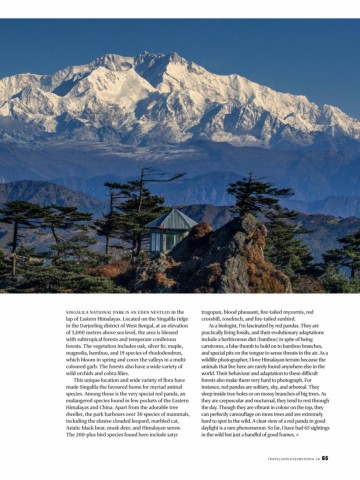
SINGALILA NATIONAL PARK IS AN EDEN NESTLED in the           tragopan, blood pheasant, fire-tailed myzornis, red
                              lap of Eastern Himalayas. Located on the Singalila ridge    crossbill, rosefinch, and fire-tailed sunbird.
                              in the Darjeeling district of West Bengal, at an elevation     As a biologist, I’m fascinated by red pandas. They are
                              of 3,000 metres above sea level, the area is blessed        practically living fossils, and their evolutionary adaptations
                              with subtropical forests and temperate coniferous           include a herbivorous diet (bamboo) in spite of being
                              forests. The vegetation includes oak, silver fir, maple,    carnivores, a false thumb to hold on to bamboo branches,
                              magnolia, bamboo, and 19 species of rhododendron,           and special pits on the tongue to sense threats in the air. As a
                              which bloom in spring and cover the valleys in a multi-     wildlife photographer, I love Himalayan terrain because the
                              coloured garb. The forests also have a wide variety of      animals that live here are rarely found anywhere else in the
                              wild orchids and cobra lilies.                              world. Their behaviour and adaptation to these difficult
                                 This unique location and wide variety of flora have      forests also make them very hard to photograph. For
                              made Singalila the favoured home for myriad animal          instance, red pandas are solitary, shy, and arboreal. They
                              species. Among those is the very special red panda, an      sleep inside tree holes or on mossy branches of big trees. As
                              endangered species found in few pockets of the Eastern      they are crepuscular and nocturnal, they tend to rest through
                              Himalayas and China. Apart from the adorable tree           the day. Though they are vibrant in colour on the top, they
                              dweller, the park harbours over 30 species of mammals,      can perfectly camouflage on moss trees and are extremely
                              including the elusive clouded leopard, marbled cat,         hard to spot in the wild. A clear view of a red panda in good
                              Asiatic black bear, musk deer, and Himalayan serow.         daylight is a rare phenomenon. So far, I have had 65 sightings
                              The 200-plus bird species found here include satyr          in the wild but just a handful of good frames.


                                                                                                                       TR AV E L A NDLE I S U R E IND I A .IN   65

