


Page 17 - BBC Wildlife Volume 36 #11
P. 17
WILD NOVEMBER
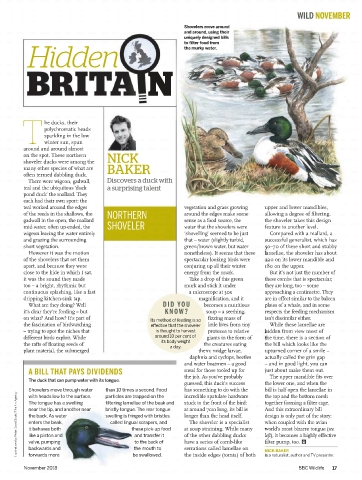
Shovelers move around
and around, using their
uniquely designed bills
to filter food from
Hidden
the murky water.
N
he ducks, their
polychromatic heads
sparkling in the low
T winter sun, spun
around and around almost
on the spot. These northern
shoveler ducks were among the NICK
many other species of what are BAKER
often termed dabbling duck.
There were wigeon, gadwall, Discovers a duck with
teal and the ubiquitous ‘duck a surprising talent
pond duck’ the mallard. They
each had their own sport: the
teal worked around the edges vegetation and grass growing upper and lower mandibles,
of the reeds in the shallows, the NORTHERN around the edges make some allowing a degree of filtering,
gadwall in the open, the mallard sense as a food source, the the shoveler takes this design
mid-water, often up-ended, the SHOVELER water that the shovelers were feature to another level.
wigeon leaving the water entirely ‘shovelling’ seemed to be just Compared with a mallard, a
and grazing the surrounding that – water (slightly turbid, successful generalist, which has
short vegetation. green/brown water, but water 0–70 of these short and stubby
However it was the motion nonetheless). It seems that these amellae, the shoveler has about
of the shovelers that set them spectacular looking birds were 20 on its lower mandible and
apart, and because they were conjuring up all their winter 180 on the upper.
close to the hide in which I sat, energy from the murk. But it’s not just the number of
it was the sound they made Take a drop of this green these combs that is spectacular;
too – a bright, rhythmic but murk and stick it under they are long, too – some
continuous splashing, like a fast a microscope at 30x approaching a centimetre. They
dripping kitchen-sink tap. magnification, and it are in effect similar to the baleen
What are they doing? Well DID YOU becomes a nutritious plates of a whale, and in some
it’s clear they’re feeding – but KNOW ? soup – a seething, respects the feeding mechanism
on what? And how? It’s part of fizzing mass of isn’t dissimilar either.
Its method of feeding is so
the fascination of birdwatching effective that the shoveler little lives from tiny While these lamellae are
– trying to spot the niches that is thought to harvest protozoa to relative hidden from view most of
different birds exploit. While around 10 per cent of giants in the form of he time, there is a section of
its body weight
the rafts of floating seeds of the creatures eating the bill which looks like the
a day.
plant material, the submerged them: midge larvae, upturned corner of a smile –
daphnia and cyclops, beetles actually called the grin gap
and water boatmen – a good – and in good light, you can
A BILL THAT PAYS DIVIDENDS meal for those tooled up for just about make them out.
the job. As you’ve probably The upper mandible fits over
The duck that can pump water with its tongue.
guessed, this duck’s success the lower one, and when the
Shovelers move through water than 10 times a second. Food has something to do with the bill is half open the lamellae in
Illustrations by Peter David Scott/The Art Agency near the tip, and another near bristly tongue.The rear tongue at around 7cm long, its bill is And this extraordinary bill
the top and the bottom mesh
incredible spatulate hardware
particles are trapped on the
with heads low to the surface.
together forming a filter cage.
stuck to the front of the bird:
The tongue has a swelling
filtering lamellae of the beak and
design is only part of the story:
longer than the head itself.
the back.As water
swelling is fringed with bristles
The shoveler is a specialist
when coupled with the avian
called lingual scrapers, and
enters the beak,
at soup straining. While many
world’s most bizarre tongue (see
these pick-up food
it behaves both
of the other dabbling ducks
left), it becomes a highly effective
and transfer it
like a piston and
filter pump, too.
have a series of comb-like
valve, pumping
to the back of
backwards and
the mouth to
the inside edges (tomia) of both
forwards more
a naturalist, author and TV presenter.
November 2018 be swallowed. serrations called lamellae on ICK BAKER BBC Wildlife 17

