


Page 151 - (DK Eyewitness) Travel Guide - Italy
P. 151
VERONA   І   149


                           Romeo and Juliet
                           The tragic story of Romeo and Juliet, two young lovers from rival families,
                           was written by Luigi da Porto of Vicenza in the 1520s and has inspired
                           countless dramas, films and ballets.
                             At the Casa di Giulietta (Juliet’s house), No. 23 Via Cappello, Romeo
                           is said to have climbed to Juliet’s balcony; in reality this is a restored
                           13th-century inn. Crowds throng to see the simple façade and stand on
                           the small marble balcony. The run-down Casa di Romeo is a few streets
                           away, in Via Arche Scaligeri.
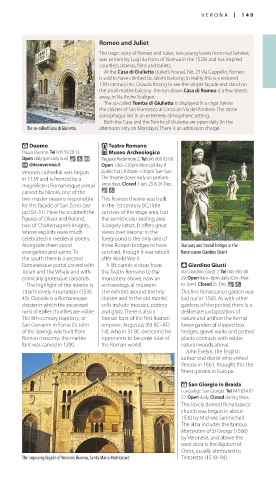
                             The so-called Tomba di Giulietta is displayed in a crypt below
                           the cloister of San Francesco al Corso on Via del Pontiere. The stone
                           sarcophagus lies in an extremely atmospheric setting.
                             Both the Casa and the Tomba di Giulietta are open daily (in the
        The so-called Casa di Giulietta  afternoon only on Mondays). There is an admission charge.

       R Duomo             T Teatro Romano
       Piazza Duomo. Tel 045 59 28 13.    E Museo Archeologico
       Open daily (pm only Sun). & 7 ^   Regaste Redentore 2. Tel 045 800 03 60.
       ∑ chieseverona.it   Open 1:30–7:30pm Mon (all day if
       Verona’s cathedral was begun    public hol); 8:30am–7:30pm Tue–Sun.
       in 1139 and is fronted by a   The theatre closes early on perform-
       magnificent Romanesque portal   ance days. Closed 1 Jan, 25 & 26 Dec.
       carved by Nicolò, one of the   & 7
       two master masons responsible   This Roman theatre was built
       for the façade of San Zeno (see   in the 1st century BC; little
       pp150–51). Here he sculpted the   survives of the stage area, but
       figures of Oliver and Roland,   the semicircular seating area
       two of Charlemagne’s knights,   is largely intact. It offers great
       whose exploits were much   views over Verona: in the
       celebrated in medieval poetry.   foreground is the only one of
       Alongside them stand   three Roman bridges to have   Statuary and formal hedges in the
       evangelists and saints. To    survived, though it was rebuilt   Renaissance Giardino Giusti
       the south there is a second   after World War II.
       Romanesque portal carved with     A lift carries visitors from    Y Giardino Giusti
       Jonah and the Whale and with   the Teatro Romano to the   Via Giardino Giusti 2. Tel 045 803 40
       comically grotesque caryatids.  monastery above, now an   29. Open 9am–8pm daily (Oct–Mar:
         The highlight of the interior is   archaeological museum.    to 7pm). Closed 25 Dec. & 7
       Titian’s lovely Assumption (1535–  The exhibits around the tiny   This fine Renaissance garden was
       40). Outside is a Romanesque   cloister and in the old monks’   laid out in 1580. As with other
       cloister in which the excavated   cells include mosaics, pottery   gardens of the period, there is a
       ruins of earlier churches are visible.  and glass. There is also a    deliberate juxtaposition of
       The 8th-century baptistry, or   bronze bust of the first Roman   nature and artifice: the formal
       San Giovanni in Fonte (St John    emperor, Augustus (63 BC–AD   lower garden of clipped box
       of the Spring), was built from   14), who in 31 BC overcame his   hedges, gravel walks and potted
       Roman masonry; the marble   opponents to become ruler of   plants contrasts with wilder,
       font was carved in 1200.  the Roman world.  natural woods above.
                                                 John Evelyn, the English
                                               author and diarist who visited
                                               Verona in 1661, thought this the
                                               finest garden in Europe.
                                               R San Giorgio in Braida
                                               Lungadige San Giorgio. Tel 045 834 02
                                               32. Open daily. Closed during Mass.
                                               This lovely domed Renaissance
                                               church was begun in about
                                               1530 by Michele Sanmicheli.
                                               The altar includes the famous
                                               Martyrdom of St George (1566)
                                               by Veronese, and above the
                                               west door is the Baptism of
                                               Christ, usually attributed to
       The imposing façade of Verona’s Duomo, Santa Maria Matricolare  Tintoretto (1518–94).


   148-149_EW_Italy.indd   149                                4/4/17   5:33 PM

