


Page 164 - (DK Eyewitness) Travel Guide - Italy
P. 164
162   І   NOR THEAST  IT AL Y

       Exploring Padua
       Padua is a city of many attractions, with a rich history: this is
       reflected in the major museum complex which occupies a
       group of 14th-century monastic buildings attached to the
       church of the Eremitani, a reclusive Augustinian order. Next
       door is the Cappella degli Scrovegni (see pp160–61). Padua is,
       in addition, the setting for one of Italy’s most important
       churches – the splendid Basilica di Sant’Antonio – and for
       one of the earliest universities to be founded in Italy.

       E Chiesa degli Eremitani   The Museo Civico Eremitani
       and Museo Civico Eremitani  holds a coin collection featuring
       Piazza Eremitani 8. Tel 049 820 45    rare Roman medallions and an
       51. Chapel: Open daily. Museum:   almost complete set of Venetian
       Open Tue–Sun. Closed 1 Jan, 1 May,   coinage, an archaeological
       25 & 26 Dec. & 7 ^ =   section and an art gallery.
       ∑ turismopadova.it    The rich archaeological
       The Eremitani church, built    collection contains interesting
       from 1276 to 1306, contains   Roman tombs, fine mosaics and   15th-century Angels in Armour by
       magnificent roof and wall   impressive life-size statues.   Guariento, Museo Civico Eremitani
       tombs. Among them is that of   Renaissance bronzes include the
       Marco Benavides (1489–1582),    comical Drinking Satyr by Il Riccio   Padua, a preacher who modelled
       a professor of law at    (1470–1532).   himself on St Francis of Assisi.
       the city university,        The 14th-century   Although he was a simple man
       whose Renaissance        crucifix from the   who rejected worldly wealth, the
       tomb was the             Cappella degli   citizens of Padua built a lavish
       work of Florentine        Scrovegni is in the   church to serve as his shrine.
       architect                 Quadreria Emo     The influence of Byzantine
       Ammannati (1511–          Capodilista, as well as   architecture is clearly visible in
       92). Celebrated            works by Giotto,   the basilica’s outline: a cone-
       frescoes (1454–7)          and 15th- to 18th-   shaped central dome rises
       by Mantegna,               century paintings   above seven encircling domes;
       portraying scenes   A 1st-century AD tomb in the   from the Venetian   the façade combines Gothic
       from the lives of    archaeological collection  and Flemish schools.  and Romanesque elements.
       St James and St                           Inside, the high altar features
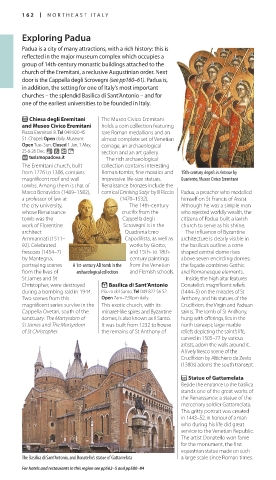
       Christopher, were destroyed   R Basilica di Sant’Antonio  Donatello’s magnificent reliefs
       during a bombing raid in 1944.   Piazza del Santo. Tel 049 822 56 52.   (1444–5) on the miracles of St
       Two scenes from this   Open 7am–7:30pm daily.  Anthony, and his statues of the
       magnificent series survive in the   This exotic church, with its   Crucifixion, the Virgin and Paduan
       Cappella Ovetari, south of the   minaret-like spires and Byzantine   saints. The tomb of St Anthony,
       sanctuary: The Martyrdom of    domes, is also known as Il Santo.   hung with offerings, lies in the
       St James and The Martyrdom    It was built from 1232 to house   north transept; large marble
       of St Christopher.  the remains of St Anthony of   reliefs depicting the saint’s life,
                                               carved in 1505–77 by various
                                               artists, adorn the walls around it.
                                               A lively fresco scene of the
                                               Crucifixion by Altichiero da Zevio
                                               (1380s) adorns the south transept.
                                               P Statue of Gattamelata
                                               Beside the entrance to the basilica
                                               stands one of the great works of
                                               the Renaissance: a statue of the
                                               mercenary soldier Gattamelata.
                                               This gritty portrait was created
                                               in 1443–52, in honour of a man
                                               who during his life did great
                                               service to the Venetian Republic.
                                               The artist Donatello won fame
                                               for the monument, the first
                                               equestrian statue made on such
       The Basilica di Sant’Antonio, and Donatello’s statue of Gattamelata  a large scale since Roman times.
       For hotels and restaurants in this region see pp562–5 and pp580–84


   162-163_EW_Italy.indd   162                                4/4/17   5:33 PM
     Eyewitness Travel   LAYERS PRINTED:
     Catalogue template    “UK” LAYER
     (Source v1.2)
     Date 12th June 2012
     Size 125mm x 217mm

