


Page 267 - (DK Eyewitness) Travel Guide - Italy
P. 267
EMILIA-ROM A GNA 265
+ Castello Estense
Largo Castello. Tel 0532 29 92 33.
Open Tue–Sun (Sep–Mar: daily).
Closed public hols. &
With its towers and battle-
ments, the Este family’s dynastic
seat (begun 1385) looms over
the town centre. Ferrante and
Giulio d’Este were incarcerated
in its dungeons for plotting to
overthrow Alfonso I d’Este.
Parisina d’Este, wife of Nicolò III,
was executed here for having
an affair with Ugo, her
illegitimate stepson.
P Palazzo del Comune
Piazza Municipale.
Bronze statues of Nicolò III
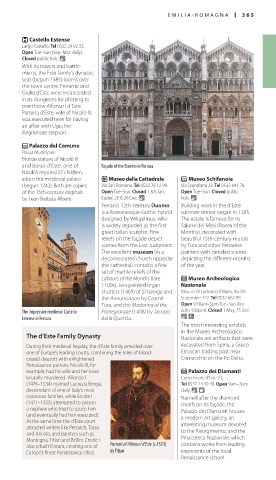
and Borso d’Este, one of Façade of the Duomo in Ferrara
Nicolò’s reputed 27 children,
adorn this medieval palace E Museo della Cattedrale P Museo Schifanoia
(begun 1243). Both are copies Via San Romano. Tel 0532 76 12 99. Via Scandiana 23. Tel 0532 641 78.
of the 15th-century originals Open Tue–Sun. Closed 1 & 6 Jan, Open Tue–Sun. Closed public
by Leon Battista Alberti. Easter, 25 & 26 Dec. & hols. &
Ferrara’s 12th-century Duomo Building work in the d’Este
is a Romanesque-Gothic hybrid summer retreat began in 1385.
designed by Wiligelmus, who The estate is famous for its
is widely regarded as the first Salone dei Mesi (Room of the
great Italian sculptor. Fine Months), decorated with
reliefs on the façade depict beautiful 15th-century murals
scenes from the Last Judgment. by Tura and other Ferrarese
The excellent museum (in a painters with detailed scenes
deconsecrated church opposite depicting the different months
the cathedral) contains a fine of the year.
set of marble reliefs of the
Labours of the Months (late E Museo Archeologico
1100s), two painted organ Nazionale
shutters (1469) of St George and Palazzo di Ludovico il Moro, Via XX
the Annunciation by Cosmè Settembre 122. Tel 0532 662 99.
Tura, and the Madonna of the Open 9:30am–5pm Tue–Sun (last
The impressive medieval Castello Pomegranate (1408) by Jacopo adm 4:30pm). Closed 1 May, 25 Dec.
Estense in Ferrara della Quercia. & 7
The most interesting exhibits
in the Museo Archeologico
The d’Este Family Dynasty Nazionale are artifacts that were
During their medieval heyday, the d’Este family presided over excavated from Spina, a Greco-
one of Europe’s leading courts, combining the roles of blood- Etruscan trading post near
crazed despots with enlightened Comacchio on the Po Delta.
Renaissance patrons. Nicolò III, for
example, had his wife and her lover E Palazzo dei Diamanti
brutally murdered. Alfonso I Corso Ercole d’Este 21.
(1476–1534) married Lucrezia Borgia, Tel 0532 24 49 49. Open 9am–7pm
descendant of one of Italy’s most daily. & 8
notorious families, while Ercole I Named after the diamond
(1471–1505) attempted to poison motifs on its façade, the
a nephew who tried to usurp him Palazzo dei Diamanti houses
(and eventually had him executed). a modern art gallery, an
At the same time the d’Este court interesting museum devoted
attracted writers like Petrarch, Tasso
and Ariosto, and painters such as to the Risor gimento, and the
Mantegna, Titian and Bellini. Ercole I Pinacoteca Nazionale, which
also rebuilt Ferrara, creating one of Portrait of Alfonso I d’Este (c.1523) contains works from leading
Europe’s finest Renaissance cities. by Titian exponents of the local
Renaissance school.
264-265_EW_Italy.indd 265 4/4/17 5:34 PM

