


Page 264 - (DK Eyewitness) Travel Guide - Italy
P. 264
262  І  CENTR AL  IT AL Y


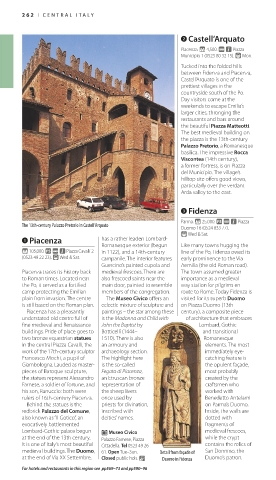
                                               2 Castell’Arquato
                                               Piacenza. * 4,500. @ n Piazza
                                               Municipio 1 (0523 80 32 15). ( Mon.
                                               Tucked into the folded hills
                                               between Fidenza and Piacenza,
                                               Castell’Arquato is one of the
                                               prettiest villages in the
                                               countryside south of the Po.
                                               Day visitors come at the
                                               weekends to escape Emilia’s
                                               larger cities, thronging the
                                               restaurants and bars around
                                               the beautiful Piazza Matteotti.
                                               The best medieval building on
                                               the piazza is the 13th-century
                                               Palazzo Pretorio, a Romanesque
                                               basilica. The impressive Rocca
                                               Viscontea (14th century),
                                               a former fortress, is on Piazza
                                               del Municipio. The village’s
                                               hilltop site offers good views,
                                               particularly over the verdant
                                               Arda valley to the east.

                                               3 Fidenza
                                               Parma. * 25,000. V @ n Piazza
       The 13th-century Palazzo Pretorio in Castell’Arquato  Duomo 16 (0524 833 77).
                                               ( Wed & Sat.
       1 Piacenza          has a rather leaden Lombard-
                           Romanesque exterior (begun    Like many towns hugging the
       * 105,000. V @ n Piazza Cavalli 2   in 1122), and a 14th-century   line of the Po, Fidenza owed its
       (0523 49 22 23). ( Wed & Sat.  campanile. The interior features   early prominence to the Via
                           Guercino’s painted cupola and   Aemilia (the old Roman road).
       Piacenza traces its history back   medieval frescoes. There are   The town assumed greater
       to Roman times. Located near   also frescoed saints near the   importance as a medieval
       the Po, it served as a fortified   main door, painted to resemble   way station for pilgrims en
       camp protecting the Emilian   members of the congregation.  route to Rome. Today Fidenza is
       plain from invasion. The centre     The Museo Civico offers an   visited for its superb Duomo
       is still based on the Roman plan.  eclectic mixture of sculpture and   on Piazza Duomo (13th
         Piacenza has a pleasantly   paintings – the star among these   century), a composite piece
       understated old centre full of   is the Madonna and Child with   of architecture that embraces
       fine medieval and Renaissance   John the Baptist by   Lombard, Gothic
       buildings. Pride of place goes to   Botticelli (1444–   and transitional
       two bronze equestrian statues   1510). There is also    Romanesque
       in the central Piazza Cavalli, the   an armoury and   elements. The most
       work of the 17th-century sculptor  archaeology section.   immediately eye-
       Francesco Mochi, a pupil of   The highlight here    catching feature is
       Giambologna. Lauded as master-   is the so-called   the opulent façade,
       pieces of Baroque sculpture,   Fegato di Piacenza,    most probably
       the statues represent Alessandro   an Etruscan bronze   created by the
       Farnese, a soldier of fortune, and  representation of    craftsmen who
       his son, Ranuccio: both were   the sheep livers    worked with
       rulers of 16th-century Piacenza.  once used by    Benedetto Antelami
         Behind the statues is the    priests for divination,   on Parma’s Duomo.
       red brick Palazzo del Comune,    inscribed with    Inside, the walls are
       also known as “Il Gotico”, an   deities’ names.  dotted with
       evocatively battlemented                       fragments of
       Lombard-Gothic palace begun   E Museo Civico   medieval frescoes,
       at the end of the 13th century.    Palazzo Farnese, Piazza   while the crypt
       It is one of Italy’s most beautiful   Cittadella. Tel 0523 49 26   contains the relics of
       medieval buildings. The Duomo,   61. Open Tue–Sun.   Detail from façade of   San Donnino, the
       at the end of Via XX Settembre,   Closed public hols. &  Duomo in Fidenza  Duomo’s patron.
       For hotels and restaurants in this region see  pp569–73 and pp590–96


   262-263_EW_Italy.indd   262                                4/4/17   5:34 PM
     Eyewitness Travel   LAYERS PRINTED:
     Catalogue template    “UK” LAYER
     (Source v1.3)
     Date 13th June 2012
     Size 125mm x 217mm

