


Page 333 - (DK Eyewitness) Travel Guide - Italy
P. 333
TUSC AN Y 331
8 Vinci
Florence. * 15,000. @ n Corso
Gramsci 110 (0573 37 44 01). ( Wed.
The birthplace of Leonardo da
Vinci (1452–1519), this hilltop
town celebrates the genius in
the Museo Leonardiano, in the Detail of frieze (1514–25) by Giovanni della Robbia, Ospedale del Ceppo
13th-century castle. Among the
displays are wooden models monuments. The finest of these, R Cappella del Tau
of Leonardo’s machines and in the south aisle, is the tomb Corso Silvano Fedi 70. Tel 0573 322 04.
inventions; most are based on of Cino da Pistoia. He was a Open 8:30am–1:30pm Mon–Sat.
drawings from his notebooks, friend of Dante and fellow The Cappella del Tau (1360)
copies of which are shown along- poet, and is depicted in a relief is so called because the monks
side. These include a bicycle, his (1337) lecturing to a class of who built it wore on their
conception of a car, an armoured young boys. cloaks the letter T (tau in Greek),
tank and even a machinegun. Nearby is the chapel of symbolizing a crutch and their
St James and its extraordinary work with the sick and disabled.
E Museo Leonardiano silver altar decorated with more Inside there are frescoes by
Castello dei Conti Guidi. Tel 0571 93 than 600 statues and reliefs. Niccolò di Tommaso on The
32 51. Open 9:30am–6pm daily (Mar– Although the earliest of these Creation and the Life of St Anthony
Oct: to 7pm). & dates from 1287, the altar was Abbot (1370). Two doors down,
not completed until 1456. the Palazzo Tau has work by
One of the craftsmen Marino Marini, Pistoia’s best-
involved was Brunelleschi, known 20th-century artist.
who began his career as a
silversmith before turning
to architecture. Also in
the Piazza del Duomo is
the octagonal Baptistry,
completed in 1359.
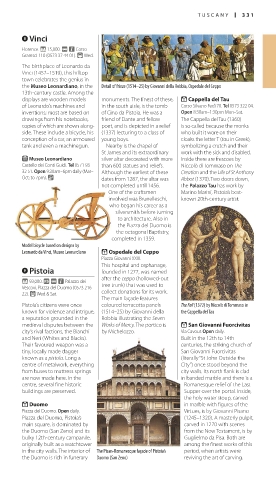
Model bicycle based on designs by
Leonardo da Vinci, Museo Leonardiano R Ospedale del Ceppo
Piazza Giovanni XXIII.
This hospital and orphanage,
9 Pistoia founded in 1277, was named
after the ceppo (hollowed-out
* 93,000. V @ n Palazzo dei
Vescovi, Piazza del Duomo (0573 216 tree trunk) that was used to
22). ( Wed & Sat. collect donations for its work.
The main façade features
Pistoia’s citizens were once coloured terracotta panels The Fall (1372) by Niccolò di Tommaso in
known for violence and intrigue, (1514–25) by Giovanni della the Cappella del Tau
a reputation grounded in the Robbia illustrating the Seven
medieval disputes between the Works of Mercy. The portico is R San Giovanni Fuorcivitas
city’s rival factions, the Bianchi by Michelozzo. Via Cavour. Open daily.
and Neri (Whites and Blacks). Built in the 12th to 14th
Their favoured weapon was a centuries, the striking church of
tiny, locally made dagger San Giovanni Fuorcivitas
known as a pistola. Long a (literally “St John Outside the
centre of metalwork, everything City”) once stood beyond the
from buses to mattress springs city walls. Its north flank is clad
are now made here. In the in banded marble and there is a
centre, several fine historic Romanesque relief of the Last
buildings are preserved. Supper over the portal. Inside,
the holy water stoup, carved
R Duomo in marble with figures of the
Piazza del Duomo. Open daily. Virtues, is by Giovanni Pisano
Piazza del Duomo, Pistoia’s (1245–1320). A masterly pulpit,
main square, is dominated by carved in 1270 with scenes
the Duomo (San Zeno) and its from the New Testament, is by
bulky 12th-century campanile, Guglielmo da Pisa. Both are
originally built as a watchtower among the finest works of this
in the city walls. The interior of The Pisan-Romanesque façade of Pistoia’s period, when artists were
the Duomo is rich in funerary Duomo (San Zeno) reviving the art of carving.
330-331_EW_Italy.indd 331 4/4/17 5:35 PM

