


Page 36 - (DK Eyewitness) Travel Guide - Italy
P. 36
34 INTRODUCING IT AL Y
Italian Architecture
The buildings of Italy span almost 3,000 years,
drawing influences from a wide variety of sources.
Etruscan and Roman buildings borrowed heavily
from ancient Greece, while in later centuries
Norman, Arabic and Byzantine styles coloured
Italy’s Romanesque and Gothic architecture.
Classical ideals infused the country’s Renaissance
buildings, later giving way to the inspired
innovations of the Baroque period.
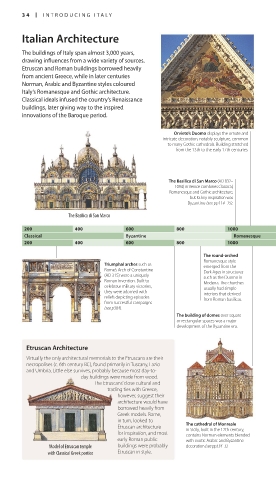
Orvieto’s Duomo displays the ornate and
intricate decoration, notably sculp ture, common
to many Gothic cathedrals. Building stretched
from the 13th to the early 17th centuries.
The Basilica di San Marco (AD 832–
1094) in Venice combines Classical,
Romanesque and Gothic architecture,
but its key inspiration was
Byzantine (see pp114–15).
The Basilica di San Marco
200 400 600 800 1000 1200
Classical Byzantine Romanesque
200 400 600 800 1000 1200
The round-arched
Romanesque style
Triumphal arches such as emerged from the
Rome’s Arch of Constantine Dark Ages in structures
(AD 315) were a uniquely such as the Duomo in
Roman invention. Built to Modena. The churches
celebrate military victories, usually had simple
they were adorned with interiors that derived
reliefs depicting episodes from Roman basilicas.
from successful campaigns
(see p384).
The building of domes over square
or rectangular spaces was a major
development of the Byzantine era.
Etruscan Architecture
Virtually the only architectural memorials to the Etruscans are their
necropolises (c. 6th century BC), found primarily in Tuscany, Lazio
and Umbria. Little else survives, probably because most day-to-
day buildings were made from wood.
The Etruscans’ close cultural and
trading ties with Greece,
however, suggest their
architecture would have
borrowed heavily from
Greek models. Rome,
in turn, looked to The cathedral of Monreale
Etruscan architecture in Sicily, built in the 12th century,
for inspiration, and most contains Norman elements blended
early Roman public with exotic Arabic and Byzantine
Model of Etruscan temple buildings were probably decoration (see pp534–5).
with Classical Greek portico Etruscan in style.
034-035_EW_Italy.indd 34 4/4/17 5:31 PM

