


Page 40 - (DK Eyewitness) Travel Guide - Italy
P. 40
38 I n TRODUCI n g IT a L y
Writers, Poets and Dramatists
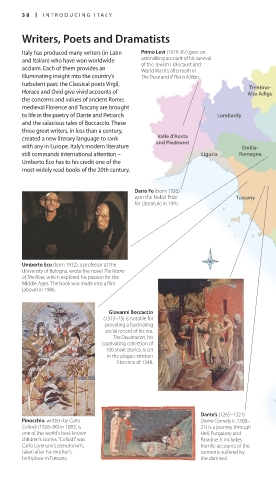
Italy has produced many writers (in Latin Primo Levi (1919–87) gave an
and Italian) who have won worldwide astonishing account of his survival
of the Jewish Holocaust and
acclaim. Each of them provides an World War II’s aftermath in
illuminating insight into the country’s The Truce and If This Is A Man.
turbulent past: the Classical poets Virgil, Trentino-
Horace and Ovid give vivid accounts of Alto Adige
the concerns and values of ancient Rome; The Veneto
medieval Florence and Tuscany are brought and Friuli
to life in the poetry of Dante and Petrarch Lombardy
and the salacious tales of Boccaccio. These
three great writers, in less than a century,
Valle d’Aosta
created a new literary language to rank and Piedmont
with any in Europe. Italy’s modern literature Emilia-
still commands international attention – Liguria Romagna
Umberto Eco has to his credit one of the
most widely read books of the 20th century.
Dario Fo (born 1926)
won the Nobel Prize Tuscany
for Literature in 1997.
Umberto Eco (born 1932), a professor at the
University of Bologna, wrote the novel The Name
of The Rose, which explored his passion for the
Middle Ages. The book was made into a film
(above) in 1986.
Giovanni Boccaccio
(1313–75) is notable for
providing a fascinating
social record of his era.
The Decameron, his
captivating collection of
100 short stories, is set
in the plague-stricken
Florence of 1348.
Dante’s (1265–1321)
Pinocchio, written by Carlo Divine Comedy (c.1308–
Collodi (1826–90) in 1883, is 21) is a journey through
one of the world’s best-known Hell, Purgatory and
children’s stories. “Collodi” was Paradise. It includes
Carlo Lorenzini’s pseudonym, horrific accounts of the
taken after his mother’s torments suffered by
birthplace in Tuscany. the damned.
038-039_EW_Italy.indd 38 20/03/15 10:59 am
Eyewitness Travel LAYERS PRINTED:
Flashmap template “UK” LAYER
(Source v1.1)
Date 19th July 2012
Size 125mm x 217mm

