


Page 375 - (DK Eyewitness) Travel Guide - Italy
P. 375
LE M ARCHE 373
and some original manu scripts lie Fortuna, it became the terminus
in the Conservatorio Rossini. His of the Via Flaminia (an important
operas are performed in Teatro consular road from Rome) and
Rossini in Piazza Lazzarini during the largest Roman colony on
the annual August music festival. the Adriatic coast. The Arco
d’Augusto (AD 2), on Via Arco
E Musei Civici d’Augusto, is Fano’s most
Piazza Mosca 29. Tel 0721 38 72 95. significant ancient monument,
Open Tue–Sun. Closed 1 Jan, having narrowly escaped
25 Dec. & destruction at the hands of
E Museo Archeologico Oliveriano Federico da Montefeltro in 1463.
Via Mazza 97. Tel 0721 333 44. He destroyed its upper section
Open Mon–Sat. 7 while besieging the town as a
papal condottiere.
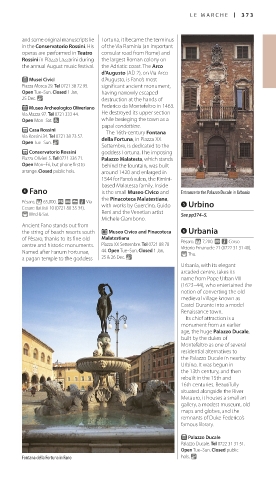
P Casa Rossini The 16th-century Fontana
Via Rossini 34. Tel 0721 38 73 57. della Fortuna, in Piazza XX
Open Tue–Sun. &
Settembre, is dedicated to the
P Conservatorio Rossini goddess Fortuna. The imposing
Piazza Olivieri 5. Tel 0721 336 71. Palazzo Malatesta, which stands
Open Mon–Fri, but phone first to behind the fountain, was built
arrange. Closed public hols. around 1420 and enlarged in
1544 for Fano’s rulers, the Rimini-
based Malatesta family. Inside
4 Fano is the small Museo Civico and Entrance to the Palazzo Ducale in Urbania
the Pinacoteca Malatestiana,
Pèsaro. * 65,000. V @ g n Via 5 Urbino
Cesare Battisti 10 (0721 80 35 34). with works by Guercino, Guido
( Wed & Sat. Reni and the Venetian artist See pp374–5.
Michele Giambono.
Ancient Fano stands out from
the string of beach resorts south E Museo Civico and Pinacoteca 6 Urbania
of Pèsaro, thanks to its fine old Malatestiana Pèsaro. * 7,200. @ n Corso
centre and historic monuments. Piazza XX Settembre. Tel 0721 88 78 Vittorio Emanuele 21 (0722 31 31 40).
Named after Fanum Fortunae, 44. Open Tue–Sun. Closed 1 Jan, ( Thu.
a pagan temple to the goddess 25 & 26 Dec. &
Urbania, with its elegant
arcaded centre, takes its
name from Pope Urban VIII
(1623–44), who entertained the
notion of converting the old
medieval village known as
Castel Durante into a model
Renaissance town.
Its chief attraction is a
monument from an earlier
age, the huge Palazzo Ducale,
built by the dukes of
Montefeltro as one of several
residential alternatives to
the Palazzo Ducale in nearby
Urbino. It was begun in
the 13th century, and then
rebuilt in the 15th and
16th centuries. Beautifully
situated alongside the River
Metauro, it houses a small art
gallery, a modest museum, old
maps and globes, and the
remnants of Duke Federico’s
famous library.
E Palazzo Ducale
Palazzo Ducale. Tel 0722 31 31 51.
Open Tue–Sun. Closed public
Fontana della Fortuna in Fano hols. &
372-373_EW_Italy.indd 373 26/04/16 5:18 pm

