


Page 49 - (DK Eyewitness) Travel Guide - Italy
P. 49
INTRODUCING IT AL Y 47
THE HISTORY
OF ITALY
The concept of Italy as a geographic entity in contrast, saw a growth of independent
goes back to the time of the Etruscans, but city states, the most powerful being Venice,
Italy’s history is one of discord and division. fabu lously wealthy through trade with the
Prior to the 19th century, the only time East. Other cities, such as Genoa, Florence,
the peninsula was united was under the Milan, Pisa and Siena, also had their days
Romans, who by the 2nd century BC had of glory. Northern Italy became the most
subdued the other Italian tribes. Rome prosperous and cultured region in
became the capital of a huge empire, western Europe and it was the artists
introducing its language, laws and calendar and scholars of 15th-century Florence
to most of Europe before succumbing to who inspired the Renaissance. Small,
Germanic invaders in the 5th century AD. fragmented states, however, could not
Another important legacy of the Roman compete with great powers. In the
empire was Christianity and the position 16th century Italy’s petty kingdoms fell prey
of the pope as head of the Catholic Church. to a foreign invader, this time Spain, and
The medieval papacy summoned the Franks the north subsequently came under the
to drive out the Lombards and, in AD 800, control of Austria.
crowned the Frankish king Charlemagne One small kingdom that remained
Holy Roman Emperor. Unfortunately, what independent was Piedmont, but during
seemed to be the dawn of a new age a war between Austria and France it fell
turned out to be anything but. For five to Napoleon in 1796. In the 19th century,
centuries, popes and emperors fought to however, it was Piedmont that became
decide which of them should be in charge the focus for a movement towards a
of their nebulous empire. united Italy, a goal that was achieved in
Meanwhile, a succession of foreign 1870, thanks largely to the heroic military
invaders – Normans, Angevins and exploits of Garibaldi. In the 1920s, the Fascists
Aragonese – took advantage of the situation seized power and, in 1946, the monarchy
to conquer Sicily and the south. The north, was abandoned for today’s republic.
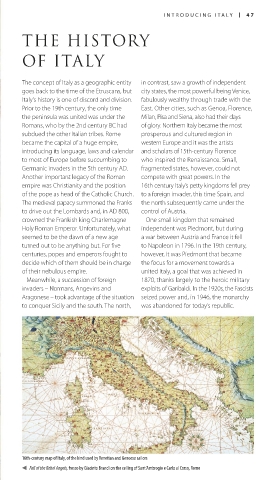
16th-century map of Italy, of the kind used by Venetian and Genoese sailors
Fall of the Rebel Angels, fresco by Giacinto Brandi on the ceiling of Sant’Ambrogio e Carlo al Corso, Rome
046-047_EW_Italy.indd 47 4/4/17 5:32 PM

