


Page 46 - (DK Eyewitness) Travel Guide - Italy
P. 46
44 INTRODUCING IT AL Y
Scientists, Inventors and Explorers
Italy has fostered a long tradition of important scientific
thought and discovery, fuelled in the Renaissance by such
men as Galileo, who searched for a new understanding of Trentino-
the universe. Meanwhile, explorers such as Alto Adige
Columbus had set off to find new worlds, a
move heralded in the 13th century by Marco Lombardy
Polo. The spirit of scientific enquiry continued
up to the 20th century, with the invention Valle d’Aosta
of radio and pioneering work in the field of and
nuclear physics. Piedmont
Emilia-
Liguria Romagna
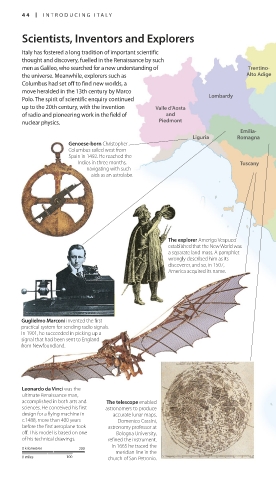
Genoese-born Christopher
Columbus sailed west from
Spain in 1492. He reached the
Indies in three months, Tuscany
navigating with such
aids as an astrolabe.
Umbria
The explorer Amerigo Vespucci
established that the New World was
a separate land mass. A pamphlet
wrongly described him as its
discoverer, and so, in 1507,
America acquired its name.
Guglielmo Marconi invented the first
practical system for sending radio signals.
In 1901, he succeeded in picking up a
signal that had been sent to England
from Newfoundland.
Leonardo da Vinci was the
ultimate Renaissance man,
accomplished in both arts and The telescope enabled
sciences. He conceived his first astronomers to produce
design for a flying machine in accurate lunar maps.
c.1488, more than 400 years Domenico Cassini,
before the first aeroplane took astronomy professor at
off. This model is based on one Bologna University,
of his technical drawings. refined the instrument.
In 1665 he traced the
0 kilometres 200
meridian line in the
0 miles 100 church of San Petronio.
044-045_EW_Italy.indd 44 4/4/17 5:32 PM
Eyewitness Travel LAYERS PRINTED:
Flashmap template “UK” LAYER
(Source v1.1)
Date 19th July 2012
Size 125mm x 217mm

