


Page 525 - (DK Eyewitness) Travel Guide - Italy
P. 525
BASILIC A T A AND C ALABRIA 523
13th centuries, such caves Archaeological Zone. Further
probably provided refuge for south, modern Policoro occupies
monks from the Byzantine what was ancient Heracleia
empire. Many chapels, gouged (founded 7th–5th century BC). Its
out of the rock, were taken over Museo Nazionale della Siritide
in the 15th century by peasants. has finds from this and other sites.
Later, a cave-dwelling Matera
evolved and by the 18th century E Museo Nazionale di
some buildings fronting the Metaponto
caves had become fairly grand Via Aristea 21. Tel 0835 74 53 27.
mansions and convents. By the Open 9am–8pm daily (from 2pm
1950s and 1960s, the Sassi were Mon). Closed pub hols. & includes
overtaken by squalor and poverty, Archaeological Zone.
and the inhabitants forcibly E Museo Nazionale della Siritide
rehoused. Carlo Levi (1912–75) The Tavole Palatine in Metaponto Via Colombo 8, Policoro. Tel 0835 97 21
drew attention to their living 54. Open 9am–7pm daily (from 2pm
conditions in his book Christ 5 Metaponto Tue). Closed 1 Jan, 1 May, 25 Dec. &
Stopped at Eboli, comparing the Metaponto Borgo. @ V to
Sassi to Dante’s Inferno. The area Metaponto. n Via Apollo Licio.
was made a UNESCO World Open 9am–1 hr before sun set daily. 6 Maratea
Heritage Site in 1993. Closed Mon am, 1 Jan, Easter, 25 Dec. Potenza. * 5,200. V @ n Piazza
Of the 120 chiese rupestri (rock- & 7 ∑ aptbasilicata.it del Gesù 32 (0973 87 69 08). ( 1st &
cut churches; www.parcomurgia. 3rd Sat of month.
it) in the Sassi and the Agri district Founded in the 7th century BC,
outside the town, Santa Maria di ancient Metaponto was once A tiny stretch of Basilicata meets
Idris in the Monte Errone area the centre of a wealthy city-state the Tyrrhenian Sea in the Gulf of
and Santa Lucia alle Malve with a philosophical tradition Policastro. This unblemished
in the Albanian quarter expounded by Pythagoras, coast is home to Maratea. Its
both contain 13th- who settled here after his small port (Maratea Inferiore) is
century frescoes. expulsion from beneath the old centre (Maratea
The Museo della Croton. Its ruins Superiore), which straddles the
Tortura (torture), in include the Tavole flank of a hill. From here the
Via San Biagio, has Palatine (6th century road climbs Monte Biagio to a
exhibits dating back BC) at the Bradano summit with breathtaking
to the time of the River bridge, 15 views, where a huge statue of
Inquisition, while columns that are the Redeemer stands.
the Museo Nazionale Church of San part of a Doric
Ridola provides a Francesco in Matera temple, probably dedi- Environs
background to Matera ca ted to Hera. The Dramatically sited Rivello, 23 km
and the Sassi. The artifacts from Museo Nazionale di Metaponto (14 miles) to the north, once had
many Neolithic trench villages, displays artifacts from the site. a largely Greek population.
necropolises and other ancient The ruins of a theatre and the Byzantine influences can be seen
sites are displayed here. Doric Temple of Apollo Lycius in the churches of Santa Maria
The Apulian-Romanesque (6th century BC) are in the del Poggio and Santa Barbara.
Duomo (13th century), in Piazza
Duomo, has a 12th-century
painting of the Madonna della
Bruna, the patro ness of Matera.
Via Duomo leads toward San
Francesco d’Assisi (13th century
with Baroque over lay). Other
churches to visit are San
Domenico and San Gio vanni
Battista on Via San Biagio (both
13th century), and the Purgatorio
(1770) on Via Ridola.
Matera is where Mel Gibson’s
The Passion of the Christ (2004)
was largely filmed.
E Museo Nazionale Ridola
Via Ridola 24. Tel 0835 31 00 58.
Open 9am–8pm daily (from 2pm
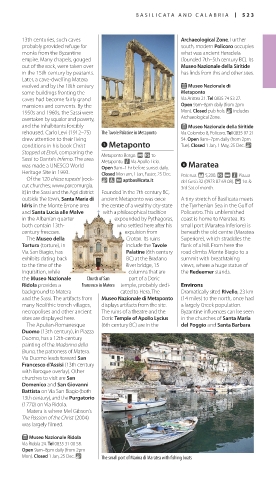
Mon). Closed 1 Jan, 25 Dec. & The small port of Marina di Maratea with fishing boats
522-523_EW_Italy.indd 523 4/5/17 9:31 AM

