


Page 529 - (DK Eyewitness) Travel Guide - Italy
P. 529
SOUTHERN IT AL Y 527
SICILY
On a crossroads in the Mediterranean, part of Europe
and Africa, yet belonging to neither, Sicily was tramped
across by half the ancient civilized world. As conquerors
came and went, they left behind elements of their
culture, resulting in the rich and varied mixture that
typifies every aspect of Sicilian life, from language,
customs and cooking to art and, most notably, the
architecture of the island.
During the 6th and 5th centuries BC, elaborate ritual of the Spanish Viceregal
there cannot have been much difference court, tend towards extravagant display.
between Athens and the Greek cities of At Noto, Ragusa, Modica, Siracusa and
Sicily. Their ruins are among the most Catania the buildings are a useful vehicle
spectacular of the ancient Greek world. for the Sicilians’ love of ornamentation,
The Romans took over in the 3rd century itself a remnant from the island’s early fling
BC, followed by the Vandals, Ostrogoths with the Arab world. The style is an
and Byzantines. Not much that is tangible expression of the nature of Sicilians, whose
has survived from the days of the Arabs, sense of pomp and pageantry is both
who ruled from the 9th to 11th centuries, magnificent and extreme.
though Palermo’s Vucciria is more souk Sicily is a curiosity, and the legacy of the
than market. The Norman era, beginning past is redolent everywhere. The fact that
in 1061, spawned brilliant artistic it is an island has intensified the cultural
achievements, such as the cathedrals of impact of each successive occupier. They
Monreale and Cefalù, while the eclecticism say that today there’s as much Phoenician,
of that period’s architecture is best seen at Greek, Arabic, Norman, Spanish or French
Santi Pietro e Paolo outside Taormina. blood in Sicilian veins as there is Italian.
The Sicilian Baroque of the 17th and 18th The resulting mixture – exotic, spicy and
centuries is just as individual. The palaces highly inflammable – has created a distinct
and churches of Palermo, reflecting the culture at the foot of Italy.
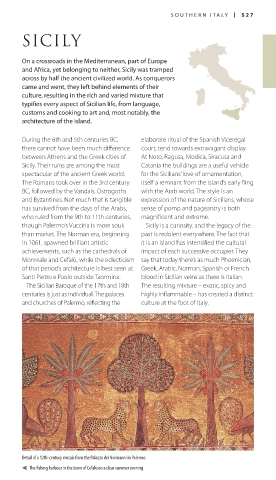
Detail of a 12th-century mosaic from the Palazzo dei Normanni in Palermo
The fishing harbour in the town of Cefalù on a clear summer evening
526-527_EW_Italy.indd 527 4/5/17 9:31 AM

