


Page 534 - (DK Eyewitness) Travel Guide - Italy
P. 534
532 SOUTHERN IT AL Y
Exploring Palermo the Rosary (1624–8) by Anthony
Van Dyck, and there are wall
East of the Quattro Canti, where Via Maqueda and Corso paintings by Luca Giordano and
Vittorio Emanuele meet, the city is sprinkled with ornate Pietro Novelli.
palaces and more churches. Squeezed behind them are
labyrinthine medieval quarters where ancient, crumbling R San Domenico
buildings still stand. Piazza San Domenico. Tel 091 32 95
88. Open 8am–2pm Tue–Sun (cloister:
from 9:30am). Museo del
R La Martorana Risorgimento: Tel 091 58 27 74. Open
Piazza Bellini. Tel 345 828 82 31. 9am–1pm Mon–Fri. Closed Aug.
Open 8:30am–1pm, 3:30–5:30pm ∑ domenicani-palermo.it
Mon–Sat; 9–10:30am Sun & hols Although the present building
(to 7pm in summer). was begun in 1640, there has
Also called Santa Maria dell’ been a Dominican church on
Ammiraglio, this church was the site since the 14th century.
built around 1140 by George of Tommaso Maria Napoli, one of
Antioch, Roger II’s admiral. The the masters of Sicilian Baroque,
design derives from Norman and created the exuberant church
Islamic traditions, with mosaics façade (1726) and square in
possibly by Greek artisans. In the front (1724). Within, the most
right aisle, King Roger receives interesting feature is Antonello
the Imperial Diadem from Gagini’s bas- relief of Santa
Christ; in the left aisle, George Caterina (1528) in the third
of Antioch is portrayed. chapel on the left. Next to the
A nearby convent, founded by church is a 14th- century cloister
Eloisa Martorana in 1193, was the that gives access to the Museo
site where the Sicilian Parliament del Risorgimento.
met in 1295 and decided to hand Stuccoed interior of the Oratorio del
the crown of Sicily to Frederick Rosario di San Domenico E Museo Archeologico
of Aragon. The church was Regionale
presented to the convent in 1433. R Oratorio del Rosario di Piazza Olivella 24. Tel 091 68 06 07.
San Domenico Open 9:30am–7pm Tue–Fri,
Via dei Bambinai 2. Open Apr–Oct: 9:30am–1pm Sat & Sun.
9am–6pm Mon–Sat (to 3pm Sat); Housed in a former monastery
Nov–Mar: 9am–3pm Mon–Sat. & 7 of the Filippini, Sicily’s most
The interior of this tiny important museum contains
16th-century chapel displays sculpture, architectural fragments
elegant Baroque decoration by and ceramics, bronzes, glassware,
the master of stucco, Giacomo jewellery, weapons and
Serpotta. Created around 1720– terracottas. The collection is taken
30, this was possibly his finest from the island’s Phoenician, Greek
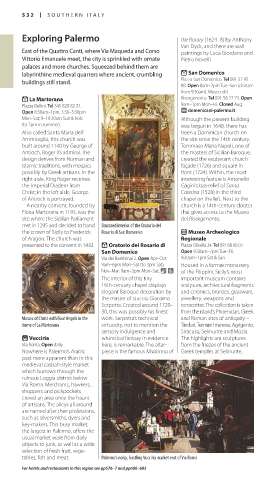
Mosaic of Christ with Four Angels in the work. Serpotta’s technical and Roman sites of antiquity –
dome of La Martorana virtuosity, not to mention the Tindari, Termini Imerese, Agrigento,
sensory indulgence and Siracusa, Selinunte and Mozia.
( Vucciria whimsical fantasy in evidence The highlights are sculptures
Via Roma. Open daily. here, is remarkable. The altar- from the friezes of the ancient
Nowhere is Palermo’s Arabic piece is the famous Madonna of Greek temples at Selinunte.
past more apparent than in this
medieval casbah-style market
which burrows through the
ruinous Loggia district below
Via Roma. Merchants, hawkers,
shoppers and pickpockets
crowd an area once the haunt
of artisans. The alleys all around
are named after their professions,
such as silversmiths, dyers and
key-makers. This busy market,
the largest in Palermo, offers the
usual market ware from daily
objects to junk, as well as a wide
selection of fresh fruit, vege-
tables, fish and meat. Palermo’s noisy, bustling Vucciria market east of Via Roma
For hotels and restaurants in this region see pp576–7 and pp600–605
532-533_EW_Italy.indd 532 4/5/17 9:31 AM

