


Page 555 - (DK Eyewitness) Travel Guide - Italy
P. 555
SARDINIA 553
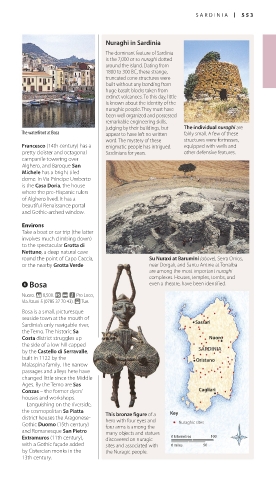
Nuraghi in Sardinia
The dominant feature of Sardinia
is the 7,000 or so nuraghi dotted
around the island. Dating from
1800 to 300 BC, these strange,
truncated cone structures were
built without any bonding from
huge basalt blocks taken from
extinct volcanoes. To this day, little
is known about the identity of the
nuraghic people. They must have
been well organized and possessed
remarkable engineering skills,
judging by their buildings, but The individual nuraghi are
The waterfront at Bosa appear to have left no written fairly small. A few of these
word. The mystery of these structures were fortresses,
Francesco (14th century) has a enigmatic people has intrigued equipped with wells and
pretty cloister and octagonal Sardinians for years. other defensive features.
campanile towering over
Alghero, and Baroque San
Michele has a bright tiled
dome. In Via Principe Umberto
is the Casa Doria, the house
where the pre-Hispanic rulers
of Alghero lived. It has a
beautiful Renaissance portal
and Gothic-arched window.
Environs
Take a boat or car trip (the latter
involves much climbing down)
to the spectacular Grotta di
Nettuno, a deep natural cave
round the point of Capo Caccia, Su Nuraxi at Barumini (above), Serra Orrios,
or the nearby Grotta Verde near Dorgali, and Santu Antine at Torralba
are among the most important nuraghi
complexes. Houses, temples, tombs, and
4 Bosa even a theatre, have been identified.
Nuoro. * 8,500. V @ n Pro Loco,
Via Azuni 5 (0785 37 70 43). ( Tue.
Bosa is a small, picturesque
seaside town at the mouth of
Sardinia’s only navigable river, Sassari
the Temo. The historic Sa
Costa district struggles up Nuoro
the side of a low hill capped
by the Castello di Serravalle, SARDINIA
built in 1122 by the Oristano
Malaspina family. The narrow
passages and alleys here have
changed little since the Middle
Ages. By the Temo are Sas
Conzas – the former dyers’ Cagliari
houses and workshops.
Languishing on the riverside,
the cosmopolitan Sa Piatta This bronze figure of a Key
district houses the Aragonese- hero with four eyes and
Gothic Duomo (15th century) four arms is among the Nuraghic sites
and Romanesque San Pietro many objects and statues
Extramuros (11th century), discovered on nuragic 0 kilometres 100
with a Gothic façade added sites and associated with 0 miles 50
by Cistercian monks in the the Nuragic people.
13th century.
552-553_EW_Italy.indd 553 05/05/2017 10:09

