


Page 61 - (DK Eyewitness) Travel Guide - Italy
P. 61
the hist or y of it al y 59
Where to See
Late Medieval Italy
Many central Italian cities and towns
have public buildings from the 13th
and 14th centuries; among the most
impressive are Palazzo Vecchio (p295)
in Florence and Siena’s Palazzo
Pubblico (p344). Smaller towns that
preserve much of their medieval
character include Volterra (p338)
and the walled Monteriggioni (p338)
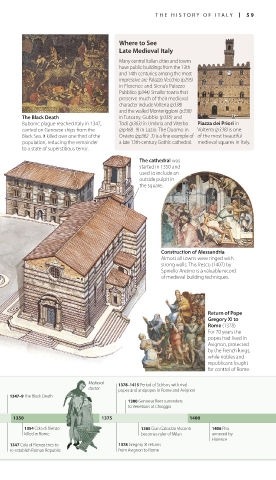
The Black Death in Tuscany, Gubbio (p356) and
Bubonic plague reached Italy in 1347, Todi (p363) in Umbria and Viterbo Piazza dei Priori in
carried on Genoese ships from the (pp468–9) in Lazio. The Duomo in Volterra (p338) is one
Black Sea. It killed over one third of the Orvieto (pp362–3) is a fine example of of the most beautiful
population, reducing the remainder a late 13th-century Gothic cathedral. medieval squares in Italy.
to a state of superstitious terror.
The cathedral was
started in 1350 and
used to include an
outside pulpit in
the square.
Construction of Alessandria
Almost all towns were ringed with
strong walls. This fresco (1407) by
Spinello Aretino is a valuable record
of medieval building techniques.
Return of Pope
Gregory XI to
Rome (1378)
For 70 years the
popes had lived in
Avignon, protected
by the French kings,
while nobles and
republicans fought
for control of Rome.
Medieval 1378–1415 Period of Schism, with rival
doctor
popes and antipopes in Rome and Avignon
1347–9 The Black Death
1380 Genoese fleet surrenders
to Venetians at Chioggia
1350 1375 1400
1354 Cola di Rienzo 1385 Gian Galeazzo Visconti 1406 Pisa
killed in Rome becomes ruler of Milan annexed by
Florence
1347 Cola di Rienzo tries to 1378 Gregory XI returns
re-establish Roman Republic from Avignon to Rome
058-059_EW_Italy.indd 59 20/03/15 10:59 am

