


Page 67 - (DK Eyewitness) Travel Guide - Italy
P. 67
THE HIST OR Y OF IT AL Y 65
Where to See 18th-century Italy
The 18th century produced two of Rome’s best-
loved tourist attractions: the Spanish Steps (p413)
and the Trevi Fountain (pp414–15). It was also the
age of the first purpose-built museums, including
the Vatican’s Museo Pio-Clementine (p425). The
Neo-Classical sculpture of Antonio Canova (1757–
1822) was immensely popular during this period.
His tomb is in Santa Maria Gloriosa dei Frari in
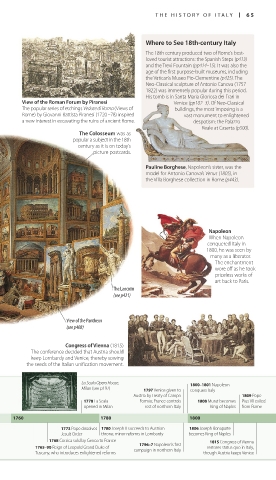
View of the Roman Forum by Piranesi Venice (pp102–3). Of Neo-Classical
The popular series of etchings Vedute di Roma (Views of buildings, the most imposing is a
Rome) by Giovanni Battista Piranesi (1720 –78) inspired vast monument to enlightened
a new interest in excavating the ruins of ancient Rome. despotism: the Palazzo
Reale at Caserta (p500).
The Colosseum was as
popular a subject in the 18th
century as it is on today’s
picture postcards.
Pauline Borghese, Napoleon’s sister, was the
model for Antonio Canova’s Venus (1805), in
the Villa Borghese collection in Rome (p443).
Napoleon
When Napoleon
conquered Italy in
1800, he was seen by
many as a liberator.
The enchantment
wore off as he took
priceless works of
art back to Paris.
The Laocoön
(see p421)
View of the Pantheon
(see p408)
Congress of Vienna (1815)
The conference decided that Austria should
keep Lombardy and Venice, thereby sowing
the seeds of the Italian unification movement.
La Scala Opera House, 1800–1801 Napoleon
Milan (see p197)
1797 Venice given to conquers Italy
Austria by Treaty of Campo 1809 Pope
1778 La Scala Formio; France controls 1808 Murat becomes Pius VII exiled
opened in Milan rest of northern Italy King of Naples from Rome
1760 1780 1800
1773 Pope dissolves 1780 Joseph II succeeds to Austrian 1806 Joseph Bonaparte
Jesuit Order throne; minor reforms in Lombardy becomes King of Naples
1768 Corsica sold by Genoa to France 1815 Congress of Vienna
1765–90 Reign of Leopold Grand Duke of 1796–7 Napoleon’s first restores status quo in Italy,
Tuscany, who introduces enlightened reforms campaign in northern Italy though Austria keeps Venice
064-065_EW_Italy.indd 65 20/03/15 10:59 am

