


Page 86 - (DK Eyewitness) Travel Guide - Italy
P. 86
84 NOR THEAST IT AL Y
Understanding Architecture
in Venice and the Veneto
Trade contact with the East led medieval Venice to develop its own exotic
style – known as Venetian Gothic – blending Byzantine domes and
Islamic minarets with European Gothic pointed arches and quatrefoils.
In the 16th century, Palladio introduced his interpretations of Classical
architecture through a series of churches, public buildings and rural villas
in Venice and the Veneto. The 17th century brought the Baroque style, Andrea Palladio
though its exuberance was tempered by Palladio-influenced restraint. (1508–80)
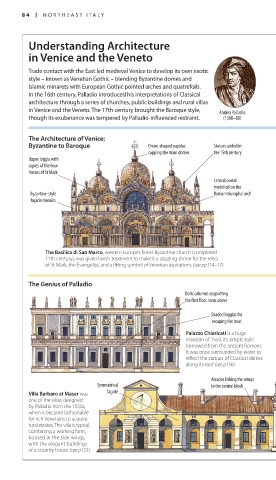
The Architecture of Venice:
Byzantine to Baroque Onion-shaped cupolas Statues added in
capping the main domes the 15th century
Upper loggia with
copies of the Four
Horses of St Mark
Central portal
modelled on the
Byzantine-style Roman triumphal arch
façade mosaics
The Basilica di San Marco, western Europe’s finest Byzantine church (completed
11th century), was given lavish treatment to make it a dazzling shrine for the relics
of St Mark, the Evangelist, and a fitting symbol of Venetian aspirations (see pp114–17).
The Genius of Palladio
Doric columns supporting
the first floor, Ionic above
Shaded loggias for
escaping the heat
Palazzo Chiericati is a huge
mansion of 1550, its simple style
borrowed from the ancient Romans.
It was once surrounded by water to
reflect the statues of Classical deities
along its roof (see p156).
Arcades linking the wings
Symmetrical to the central block
Villa Barbaro at Maser was façade
one of the villas designed
by Palladio from the 1550s,
when it became fashionable
for rich Venetians to acquire
rural estates. This villa is typical,
combining a working farm,
housed in the side wings,
with the elegant buildings
of a country house (see p153).
084-085_EW_Italy.indd 84 20/03/15 10:58 am
Eyewitness Travel LAYERS PRINTED:
Feature template “UK” LAYER
(SourceReport v1.1)
Date 3rd August 2012
Size 125mm x 217mm

