


Page 31 - Healthy (March - April 2020)
P. 31
BODY      CONFIDENCE


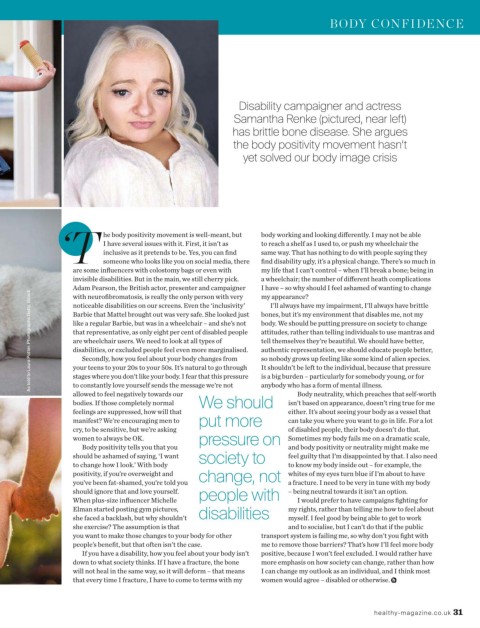
                                                            Disability campaigner and actress
                                                           Samantha Renke (pictured, near left)
                                                           has brittle bone disease. She argues
                                                           the body positivity movement hasn’t
                                                             yet solved our body image crisis


                ‘          he body positivity movement is well-meant, but    body working and looking diferently. I may not be able
                                                                  to reach a shelf as I used to, or push my wheelchair the
                           I have several issues with it. First, it isn’t as
                           inclusive as it pretends to be. Yes, you can ind
                                                                  same way. That has nothing to do with people saying they
                  T someone who looks like you on social media, there
                                                                  my life that I can’t control – when I’ll break a bone; being in
                   are some inluencers with colostomy bags or even with   ind disability ugly, it’s a physical change. There’s so much in
                   invisible disabilities. But in the main, we still cherry pick.   a wheelchair; the number of diferent heath complications
                   Adam Pearson, the British actor, presenter and campaigner   I have – so why should I feel ashamed of wanting to change
        As told to Laura Potter. Photographs Getty, iStock  Barbie that Mattel brought out was very safe. She looked just   bones, but it’s my environment that disables me, not my
                                                                  my appearance?
                   with neuroibromatosis, is really the only person with very
                   noticeable disabilities on our screens. Even the ‘inclusivity’
                                                                    I’ll always have my impairment, I’ll always have brittle
                                                                  body. We should be putting pressure on society to change
                   like a regular Barbie, but was in a wheelchair – and she’s not
                                                                  attitudes, rather than telling individuals to use mantras and
                   that representative, as only eight per cent of disabled people
                   are wheelchair users. We need to look at all types of
                                                                  tell themselves they’re beautiful. We should have better,
                                                                  authentic representation, we should educate people better,
                   disabilities, or excluded people feel even more marginalised.
                                                                  so nobody grows up feeling like some kind of alien species.
                     Secondly, how you feel about your body changes from
                                                                  It shouldn’t be left to the individual, because that pressure
                   your teens to your 20s to your 50s. It’s natural to go through
                   stages where you don’t like your body. I fear that this pressure
                   to constantly love yourself sends the message we’re not
                                                                  anybody who has a form of mental illness.
                   allowed to feel negatively towards our         is a big burden – particularly for somebody young, or for
                                                                           Body neutrality, which preaches that self-worth
                   bodies. If those completely normal   We  should       isn’t based on appearance, doesn’t ring true for me
                   feelings are suppressed, how will that                either. It’s about seeing your body as a vessel that
                   manifest? We’re encouraging men to   put more         can take you where you want to go in life. For a lot
                   cry, to be sensitive, but we’re asking                of disabled people, their body doesn’t do that.
                   women to always be OK.         pressure on            Sometimes my body fails me on a dramatic scale,
                     Body positivity tells you that you                  and body positivity or neutrality might make me
                   should be ashamed of saying, ‘I want    society to    feel guilty that I’m disappointed by that. I also need
                   to change how I look.’ With body                      to know my body inside out – for example, the
                   positivity, if you’re overweight and   change, not    whites of my eyes turn blue if I’m about to have
                   you’ve been fat-shamed, you’re told you               a fracture. I need to be very in tune with my body
                   should ignore that and love yourself.   people with   – being neutral towards it isn’t an option.
                   When plus-size inluencer Michelle                       I would prefer to have campaigns ighting for
                   Elman started posting gym pictures,                   my rights, rather than telling me how to feel about
                   she faced a backlash, but why shouldn’t  disabilities  myself. I feel good by being able to get to work
                   she exercise? The assumption is that                  and to socialise, but I can’t do that if the public
                   you want to make those changes to your body for other   transport system is failing me, so why don’t you ight with
                   people’s beneit, but that often isn’t the case.  me to remove those barriers? That’s how I’ll feel more body
                     If you have a disability, how you feel about your body isn’t   positive, because I won’t feel excluded. I would rather have
                   down to what society thinks. If I have a fracture, the bone   more emphasis on how society can change, rather than how
                   will not heal in the same way, so it will deform – that means   I can change my outlook as an individual, and I think most
                   that every time I fracture, I have to come to terms with my   women would agree – disabled or otherwise.


                                                                                              healthy-magazine.co.uk 31

