


Page 39 - Healthy (March - April 2020)
P. 39
theCLINIC


           S P O T L I G H T                O N       S U P P S           This recently discovered
                                                                          nutrient is thought
           C H O L I N E                                                  to aid liver health,

                                                                          cognitive function and

                                                                          foetal development.
                                                                          Here’s what to know


                                                                          WHAT IS IT?
                                                                          Only recognised as a required nutrient in 1998,
                                                                          choline is a water-soluble compound, which the
                                                                          body produces in small amounts. Initially, it was
                                                                          identified as a B vitamin, as they have similar
                                                                          functions in the body, and it’s still sometimes
                                                                          referred to as vitamin B4. Choline supports liver
                                                                          function, metabolism, the nervous system and
                                                                          muscle movement, while it’s critical for normal
                                                                          brain development. It’s thought to be important
                                                                          for pregnant women, too, as it may help to reduce
                                                                          the risk of neural tube defects in babies, along
                                                                          with complications such as preeclampsia and
                                                                          premature birth.
                                                                            Although the liver produces small amounts,
                                                                          dietary sources are required to achieve adequate
                                                                          levels. In the UK, there’s no recommended daily
                                                                          intake, but in the US, ‘adequate intake’ levels are
                                                                          set at 425mg per day for women and 550mg per
                                                                          day for men. Generally, it’s found in the diet from
                                                                          lecithin, a type of fat. For this reason, animal-
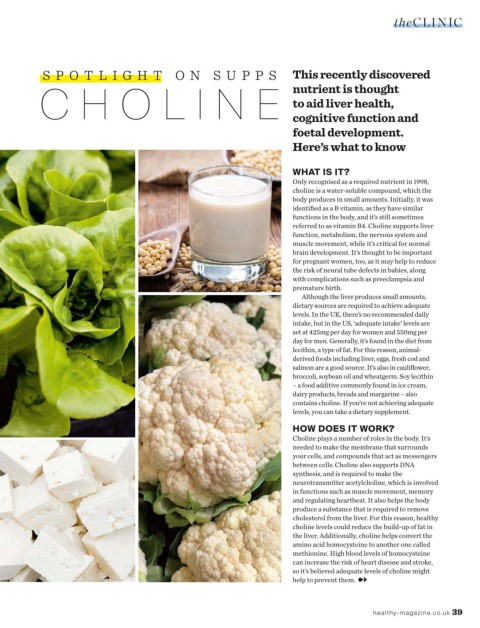
                                                                          derived foods including liver, eggs, fresh cod and
                                                                          salmon are a good source. It’s also in cauliflower,
                                                                          broccoli, soybean oil and wheatgerm. Soy lecithin
                                                                          – a food additive commonly found in ice cream,
                                                                          dairy products, breads and margarine – also
                                                                          contains choline. If you’re not achieving adequate
                                                                          levels, you can take a dietary supplement.

                                                                          HOW DOES IT WORK?
                                                                          Choline plays a number of roles in the body. It’s
                                                                          needed to make the membrane that surrounds
                                                                          your cells, and compounds that act as messengers
                                                                          between cells. Choline also supports DNA
                                                                          synthesis, and is required to make the
                                                                          neurotransmitter acetylcholine, which is involved
                                                                          in functions such as muscle movement, memory
                                                                          and regulating heartbeat. It also helps the body
                                                                          produce a substance that is required to remove
                                                                          cholesterol from the liver. For this reason, healthy
                                                                          choline levels could reduce the build-up of fat in
                                                                          the liver. Additionally, choline helps convert the
                                                                          amino acid homocysteine to another one called
                                                                          methionine. High blood levels of homocysteine
                                                                          can increase the risk of heart disease and stroke,
                                                                          so it’s believed adequate levels of choline might
                                                                          help to prevent them.


                                                                                              healthy-magazine.co.uk 39

