


Page 64 - Star Wars Insider #177
P. 64
JOHN DYKSTRA


             04


                photographing the miniatures   could control a single-axis
                at deep f-stops [focal lengths]   move. The joystick helped give
                for depth of field, so we needed   shots a sense of having been

                sharp optics that had a deep   operated by a human hand—
                stop.” Dykstra opted to use off-  rather than mathematically
                the-shelf Nikon optics, some of   programmed—bolstering the
                which Edlund customized with   sense that these shots were

                even deeper f-stops.        actually filmed by a combat
                  The Dykstraflex camera ran   pilot, at the controls in the   05

                on a modular track that could   midst of the action.
                be rearranged for different    The movements for each
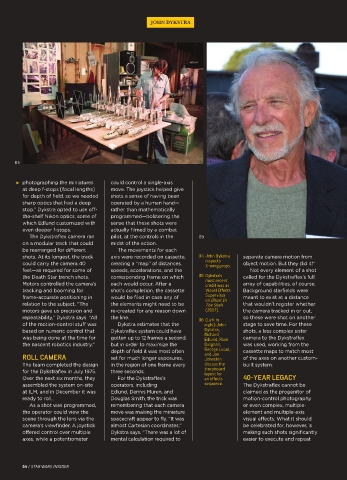
                shots. At its longest, the track   axis were recorded on cassette,   04    John Dykstra    separate camera motion from
                                                                           inspects
                could carry the camera 40   creating a “map” of distances,              object motion. But they did it!”
                                                                           X-wing props.
                feet—as required for some of   speeds, accelerations, and the             Not every element of a shot
                the Death Star trench shots.   corresponding frame on which   05   Dykstra’s   called for the Dykstrafl ex’s full
                                                                           most recent
                Motors controlled the camera’s   each would occur. After a   credit was as   array of capabilities, of course.
                tracking and booming for    shot’s completion, the cassette   Visual Effects   Background starfi elds were
                                                                           Supervisor
                frame-accurate positioning in   would be filed in case any of            meant to exist at a distance

                                                                           on Ghost In
                relation to the subject. “The   the elements might need to be   The Shell   that wouldn’t register whether
                motors gave us precision and   re-created for any reason down   (2017).  the camera tracked in or out,
                repeatability,” Dykstra says. “All   the line.                          so these were shot on another
                                                                         06   (Left to
                of the motion-control stuff was   Dykstra estimates that the   right) John   stage to save time. For these
                based on numeric control that   Dykstraflex system could have   Dykstra,   shots, a less complex sister

                                                                           Richard
                was being done at the time for   gotten up to 12 frames a second,   Edlund, Rose   camera to the Dykstrafl ex
                the nascent robotics industry.”  but in order to maximize the   Duignan,   was used, working from the
                                                                           George Lucas,
                                            depth of field it was most often   and Joe   cassette maps to match most

                ROLL CAMERA                 set for much longer exposures,   Johnston   of the axes on another custom-
                The team completed the design   in the region of one frame every   discuss the   built system.
                                                                           storyboard

                for the Dykstraflex in July 1975.   three seconds.
                                                                           layout for
                Over the next six months, they   For the Dykstrafl ex’s     an effects   40-YEAR LEGACY

                assembled the system on-site   operators, including        sequence.    The Dykstraflex cannot be
                at ILM, and in December it was   Edlund, Dennis Muren, and              claimed as the progenitor of
                ready to roll..             Douglas Smith, the trick was                motion-control photography
                  As a shot was programmed,   remembering that each camera              or even complex, multiple-
                the operator could view the   move was making the miniature             element and multiple-axis
                scene through the lens via the   spacecraft appear to fly. “It was       visual effects. What it should

                camera’s viewfinder. A joystick   almost Cartesian coordinates,”         be celebrated for, however, is

                offered control over multiple   Dykstra says. “There was a lot of       making such shots signifi cantly
                axes, while a potentiometer   mental calculation required to            easier to execute and repeat
                64 / STAR WARS INSIDER

                                                                                                               27/10/2017   15:55
          SWI177_060-065_FEAT_Dykstraflex_v9DF.indd   64                                                       27/10/2017   15:55
          SWI177_060-065_FEAT_Dykstraflex_v9DF.indd   64

