


Page 63 - Star Wars Insider #177
P. 63
JOHN DYKSTRA


                                                                                         the effects shots, however,
                                                                                         ILM opted for the all-but-
                                                                                         forgotten VistaVision format,
                                                                                         which runs standard 35mm

                                                                                         film horizontally through the
                                                                                         camera’s gate to create a
                                                                                         widescreen frame that is eight
                                                                                         perforations across.
                                                                                            “VistaVision was something
                                                                                         that Doug had lodged in my
                                                                                         mind,” Dykstra recalls. “Optical
                                                                                         printing gives you an inherent
                                                                                         degradation: an increase in
                                                                                         contrast and reduction in
                                                                                         resolution. But by using the
                                                                                         larger negative and reducing
                                                                                         it in optical printing to the
                                                                                         four-perf negative that would
                                                                                         be cut into the movie, you
                                                                                         ended up with an image that
                                                                                         was comparable to original
                                                                                         photography.”
                                                                                            VistaVision’s sideways
                                                                                         orientation also meant that

                                                                                         the film magazine would sit

               03                                                                        flat at the back of the camera.
                                                                                         This was an important
                                                                                         consideration when fi lming
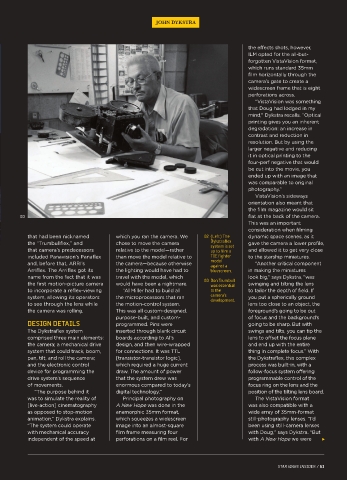
                 that had been nicknamed      which you ran the camera. We   02    (Left) The   dynamic space scenes, as it
                                                                             Dykstraflex
                 the “Trumbullfl ex,” and      chose to move the camera                   gave the camera a lower profi le,
                                                                             system is set
                 that camera’s predecessors   relative to the model—rather   up to film a   and allowed it to get very close
                 included Panavision’s Panafl ex   than move the model relative to   TIE fighter   to the starship miniatures.
                                                                             model
                 and, before that, ARRI’s     the camera—because otherwise                  “Another critical component
                                                                             against a


                 Arriflex. The Arriflex got its   the lighting would have had to   bluescreen.  in making the miniatures
                 name from the fact that it was   travel with the model, which           look big,” says Dykstra, “was
                                                                           03   Don Trumbull

                 the first motion-picture camera   would have been a nightmare.  was essential   swinging and tilting the lens
                 to incorporate a refl ex-viewing   “Al Miller had to build all   to the   to tailor the depth of fi eld. If
                                                                             camera’s
                 system, allowing its operators   the microprocessors that ran           you put a spherically ground
                                                                             development.
                 to see through the lens while   the motion-control system.              lens too close to an object, the
                 the camera was rolling.      This was all custom-designed,              foreground’s going to be out
                                              purpose-built, and custom-                 of focus and the background’s
                 DESIGN DETAILS               programmed. Pins were                      going to be sharp. But with
                 The Dykstrafl ex system       inserted through blank circuit             swings and tilts, you can tip the
                 comprised three main elements:   boards according to Al’s               lens to offset the focus plane
                 the camera; a mechanical drive   design, and then wire-wrapped          and end up with the entire
                 system that could track, boom,   for connections. It was TTL            thing in complete focus.” With
                 pan, tilt, and roll the camera;   [transistor-transistor logic],        the Dykstraflex, this complex

                 and the electronic control   which required a huge current              process was built-in, with a
                 device for programming the   draw. The amount of power                  follow-focus system offering
                 drive system’s sequence      that the system drew was                   programmable control of the
                 of movements.                enormous compared to today’s               focus ring on the lens and the
                   “The purpose behind it     digital technology.”                       position of the tilting lens board.
                 was to simulate the reality of   Principal photography on                  The VistaVision format
                 [live-action] cinematography   A New Hope was done in the               was also compatible with a
                 as opposed to stop-motion    anamorphic 35mm format,                    wide array of 35mm-format
                 animation,” Dykstra explains.   which squeezes a widescreen             still-photography lenses. “I’d
                 “The system could operate    image into an almost-square                been using still-camera lenses

                 with mechanical accuracy     film frame measuring four                   with Doug,” says Dykstra. “But
                 independent of the speed at   perforations on a film reel. For           with A New Hope we were


                                                                                                   STAR WARS INSIDER / 63


                                                                                                               27/10/2017   15:55
          SWI177_060-065_FEAT_Dykstraflex_v9DF.indd   63
          SWI177_060-065_FEAT_Dykstraflex_v9DF.indd   63                                                       27/10/2017   15:55

