


Page 86 - Combat Aircraft (January 2020)
P. 86
FIGHTER FOCUS // MIG-29 ‘FULCRUM’


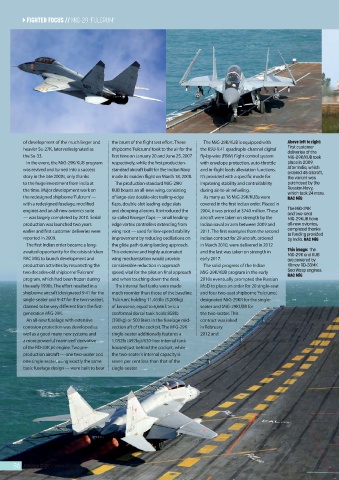
              of development of the much larger and   the brunt of the   ight test e  ort. These   The MiG-29K/KUB is equipped with   Above left to right:
              heavier Su-27K, later redesignated as   shipborne ‘Fulcrums’ took to the air for the   the KSU-9.41 quadruple-channel digital   First customer
                                                                                                           deliveries of the
              the Su-33.                       rst time on January 20 and June 25, 2007     y-by-wire (FBW)   ight control system   MiG-29K/KUB took
               In the event, the MiG-29K/KUB program   respectively, while the   rst production-  with envelope protection, auto-throttle   place in 2009.
              was revived and turned into a success   standard aircraft built for the Indian Navy   and in-  ight loads alleviation functions.   After India, which
                                                                                                           ordered 45 aircraft,
              story in the late 2000s, only thanks   made its maiden   ight on March 18, 2008.   It’s provided with a speci  c mode for   the variant was
              to the huge investment from India at   The production-standard MiG-29K/  improving stability and controllability   purchased by the
              the time. Major development work on   KUB boasts an all-new wing, consisting   during air-to-air refueling.   Russian Navy,
                                                                                                           which took 24 more.
              the redesigned shipborne ‘Fulcrum’ —   of large-size double-slot trailing-edge   As many as 16 MiG-29K/KUBs were   RAC MiG
              with a redesigned fuselage, modi  ed     aps, double-slot leading-edge slats   covered in the   rst Indian order. Placed in
              engines and an all-new avionics suite   and drooping ailerons. It introduced the   2004, it was priced at $740 million. These   The MiG-29K
                                                                                                           and two-seat
              — was largely completed by 2010. Serial   so-called Krueger   aps — small leading-  aircraft were taken on strength by the   MiG-29KUB have
              production was launched two years   edge vortex controllers extending from   Indian naval air arm between 2009 and   all-new avionics,
              earlier and   rst customer deliveries were   wing root — used for low-speed stability   2011. The   rst examples from the second   completed thanks
                                                                                                           to funding provided
              reported in 2009.              improvement by reducing oscillations on   Indian contract for 29 aircraft, ordered   by India. RAC MiG
               The   rst Indian order became a long-  the glide path during landing approach.   in March 2010, were delivered in 2012
              awaited opportunity for the crisis-stricken   This extensive and highly automated   and the last was taken on strength in   This image: The
                                                                                                           MiG-29K and KUB
              RAC MiG to launch development and   wing mechanization would provide   early 2017.           are powered by
              production activities by resurrecting the   considerable reduction in approach   The solid progress of the Indian   Klimov RD-33MK
              two decades-old shipborne ‘Fulcrum’   speed, vital for the pilot on   nal approach   MiG-29K/KUB program in the early   Sea Wasp engines.
                                                                                                           RAC MiG
              program, which had been frozen during   and when touching down the desk.   2010s eventually prompted the Russian
              the early 1990s. The e  ort resulted in a   The internal fuel tanks were made   MoD to place an order for 20 single-seat
              shipborne aircraft (designated 9-41 for the   much roomier than those of the baseline   and four two-seat shipborne ‘Fulcrums’,
              single-seater and 9-47 for the twin-seater),   ‘Fulcrum’, holding 11,463lb (5,200kg)   designated MiG-29KR for the single-
              claimed to be very di  erent from the   rst-  of kerosene, equal to 6,666 liters; a   seater and MiG-29KUBR for
              generation MiG-29K.            conformal dorsal tank holds 858lb   the two-seater. This
               An all-new fuselage with extensive   (390kg) or 500 liters in the fuselage mid-  contract was inked
              corrosion protection was developed as   section aft of the cockpit. The MiG-29K   in February
              well as a good many new systems and   single-seater additionally features a   2012 and
              a more powerful ‘marinized’ derivative   1,082lb (492kg)/630-liter internal tank
              of the RD-33K jet engine. Two pre-  housed just behind the cockpit, while
              production aircraft — one two-seater and   the two-seater’s internal capacity is
              one single-seater, using exactly the same   seven per cent less than that of the
              basic fuselage design — were built to bear   single-seater.


          86  January 2020 // www.Key.Aero


                                                                                                                  21/11/2019   20:54
        80-87 MiG-29 pt2 C.indd   86                                                                              21/11/2019   20:54
        80-87 MiG-29 pt2 C.indd   86

