


Page 93 - Combat Aircraft (January 2020)
P. 93
without reaching the QF-4N. A second   MUGU                   and a multitude of low- and high-
                          shot worked in the same manner. It was                        performance profiles. The QF-4s also
                                                                                        offered extensive video, analog, and
                          all going to plan until a sudden call of   ‘RHINOS’           digital data collection systems that
                          ‘lost link, lost link!’                                       provided real-time video and data
                           It meant the pilot on the ground who                         feedback during missions.
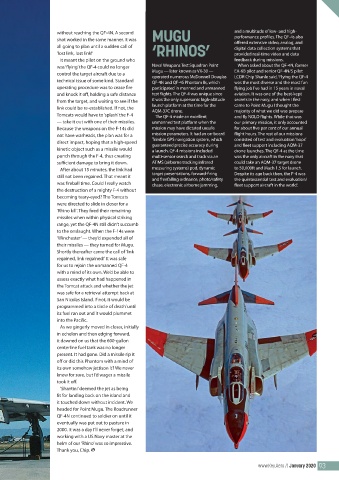
                          was ‘flying’ the QF-4 could no longer   Naval Weapons Test Squadron Point   When asked about the QF-4N, former
                          control the target aircraft due to a   Mugu — later known as VX-30 —    EA-6B pilot and senior QF-4N/S pilot
                                                                                        LCDR Chip Shanle said, ‘Flying the QF-4
                                                           operated numerous McDonnell Douglas
                          technical issue of some kind. Standard   QF-4N and QF-4S Phantom IIs, which   was the most diverse and the most fun
                          operating procedure was to cease fire   participated in manned and unmanned   flying job I’ve had in 15 years in naval
                          and knock it off, holding a safe distance   test flights. The QF-4 was unique since   aviation. It was one of the best-kept
                          from the target, and waiting to see if the   it was the only supersonic high-altitude   secrets in the navy, and when I first
                          link could be re-established. If not, the   launch platform at the time for the   came to Point Mugu I thought the
                                                           AQM-37C drone.
                                                                                        majority of what we did was prepare
                          Tomcats would have to ‘splash’ the F-4   The QF-4 made an excellent   and fly NOLO flights. While that was
                          — take it out with one of their missiles.   unmanned test platform when the   our primary mission, it only accounted
                          Because the weapons on the F-14s did   mission may have dictated unsafe   for about five per cent of our annual
                          not have warheads, the plan was for a   mission parameters. It had an on-board   flight hours. The rest of our missions
                          direct impact, hoping that a high-speed   Trimble GPS navigation system, which   consisted of test and evaluation ‘hops’
                                                           guaranteed precise accuracy during
                                                                                        and fleet support including AQM-37
                          kinetic object such as a missile would   a launch. QF-4 missions included   drone launches. The QF-4 at the time
                          punch through the F-4, thus creating   multi-sensor search and track via an   was the only aircraft in the navy that
                          sufficient damage to bring it down.  ATIMS (airborne tracking infrared   could take an AQM-37 target drone
                           After about 15 minutes, the link had   measuring systems) pod, dynamic   to 50,000ft and Mach 1.5 for launch.
                          still not been regained. That meant it   target presentations, forward-firing   Despite its age back then, the F-4 was
                                                                                        the quintessential test and evaluation/
                                                           and freefalling ordnance, photo/safety
                          was fireball time. Could I really watch   chase, electronic airborne jamming,   fleet support aircraft in the world.’
                          the destruction of a mighty F-4 without
                          becoming teary-eyed? The Tomcats
                          were directed to slide in closer for a
                          ‘Rhino kill’. They fired their remaining
                          missiles when within physical striking
                          range, yet the QF-4N still didn’t succumb
                          to the onslaught. When the F-14s were
                          ‘Winchester’ — they’d expended all of
                          their missiles — they turned for Mugu.
                          Shortly thereafter came the call of ‘link
                          regained, link regained!’ It was safe
                          for us to rejoin the unmanned QF-4
                          with a mind of its own. We’d be able to
                          assess exactly what had happened in
                          the Tomcat attack and whether the jet
                          was safe for a retrieval attempt back at
                          San Nicolas Island. If not, it would be
                          programmed into a ‘circle of death’ until
                          its fuel ran out and it would plummet
                          into the Pacific.
                           As we gingerly moved in closer, initially
                          in echelon and then edging forward,
                          it dawned on us that the 600-gallon
                          centerline fuel tank was no longer
                          present. It had gone. Did a missile rip it
                          off or did this Phantom with a mind of
                          its own somehow jettison it? We never
                          knew for sure, but I’d wager a missile
                          took it off.
                           ‘Shantini’ deemed the jet as being
                          fit for landing back on the island and
                          it touched down without incident. We
                          headed for Point Mugu. The Roadrunner
                          QF-4N continued to soldier on until it
                          eventually was put out to pasture in
                          2000. It was a day I’ll never forget, and
                          working with a US Navy master at the
                          helm of our ‘Rhino’ was so impressive.
                          Thank you, Chip.

                                                                                                www.Key.Aero // January 2020 93


                                                                                                                  21/11/2019   20:55
        88-93 QF-4 C.indd   93
        88-93 QF-4 C.indd   93                                                                                    21/11/2019   20:55

