


Page 45 - All About History - Issue 28-15
P. 45
Becoming Marilyn


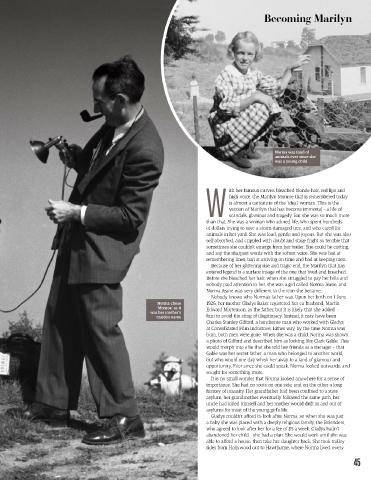
                                                                                                  Norma was fond of
                                                                                                  animals ever since she
                                                                                                  was a young child


                                                                                  ith her famous curves, bleached blonde hair, red lips and
                                                                                  high voice, the Marilyn Monroe that is remembered today
                                                                                  is almost a caricature of the ‘ideal’ woman. This is the
                                                                                  version of Marilyn that has become immortal – a life of
                                                                         W scandals, glamour and tragedy. But she was so much more
                                                                          than that. She was a woman who adored life, who spent hundreds
                                                                          of dollars trying to save a storm-damaged tree, and who cared for
                                                                          animals in her yard. She was loud, gentle and joyous. But she was also
                                                                          self-absorbed, and crippled with doubt and stage fright so terrible that
                                                                          sometimes she couldn’t emerge from her trailer. She could be cutting,
                                                                          and say the sharpest words with the softest voice. She was bad at
                                                                          remembering lines, bad at arriving on time and bad at keeping men.
                                                                           Because of her glittering rise and tragic end, the Marilyn that has
                                                                          entered legend is a surface image of the one that lived and breathed.
                                                                          Before she bleached her hair, when she struggled to pay her bills and
                                                                          nobody paid attention to her, she was a girl called Norma Jeane, and
                                                                          Norma Jeane was very different to the icon she became.
                                                                           Nobody knows who Norma’s father was. Upon her birth on 1 June
                                                        Norma chose       1926, her mother Gladys Baker registered her ex husband, Martin
                                                        ‘Monroe’ as it
                                                      was her mother’s    Edward Mortenson, as the father, but it is likely that she added
                                                        maiden name       him to avoid the sting of illegitimacy. Instead, it may have been
                                                                          Charles Stanley Gifford, a handsome man who worked with Gladys
                                                                          at Consolidated Film Industries. Either way, by the time Norma was
                                                                          born, both men were gone. When she was a child, Norma was shown
                                                                          a photo of Gifford and described him as looking like Clark Gable. This
                                                                          would morph into a lie that she told her friends as a teenager – that
                                                                          Gable was her secret father, a man who belonged to another world,
                                                                          but who would one day whisk her away to a land of glamour and
                                                                          opportunity. Ever since she could speak, Norma looked outwards, and
                                                                          sought for something more.
                                                                           It is no small wonder that Norma looked anywhere for a sense of
                                                                          importance. She had no roots on one side, and on the other a long
                                                                          history of insanity. Her grandfather had been confined to a state
                                                                          asylum, her grandmother eventually followed the same path, her
                                                                          uncle had killed himself and her mother would drift in and out of
                                                                          asylums for most of the young girl’s life.
                                                                           Gladys couldn’t afford to look after Norma, so when she was just
                                                                          a baby she was placed with a deeply religious family, the Bolenders,
                                                                          who agreed to look after her for a fee of $5 a week. Gladys hadn’t
                                                                          abandoned her child – she had a plan. She would work until she was
                                                                          able to afford a house, then take her daughter back. She took trolley
                                                                          rides from Hollywood out to Hawthorne, where Norma lived, every
                                                                                                                             45

