


Page 40 - All About History - Issue 28-15
P. 40
Through History


        MUSICALINSTRUMENTS


                                                                                                                The sitar is still
        People have been                                                                                       taught to players in
                                                                                                                its home nations
        but the one thing


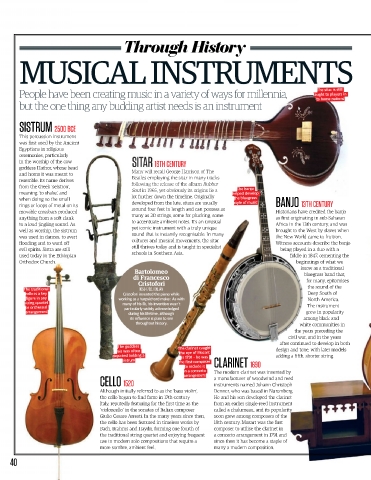
        SISTRUM  2500 BCE

        This percussion instrument
        was first used by the Ancient
        Egyptians in religious
        ceremonies, particularly
        in the worship of the cow
        goddess Hathor, whose head
        and horns it was meant to
        resemble. Its name derives
        from the Greek ‘seistron’,
                                                                                    The banjo
        meaning ‘to shake’, and                                                    helped develop
                                               lot further down the timeline. Originally
        when doing so the small                                                    the bluegrass
                                               developed from the lute, sitars are usually  style of music  BANJO 13TH CENTURY
        rings or loops of metal on its
                                               around four feet in length and can possess as
        movable crossbars produced                                                                Historians have credited the banjo
                                               many as 20 strings, some for plucking, some
        anything from a soft clank                                                                as first originating in sub-Saharan
                                               to accentuate ambient notes. It’s an unusual
        to a loud jingling sound. As                                                              Africainthe13thcentury,andwas
                                               yet iconic instrument with a truly unique
        well as worship, the sistrum                                                              broughttotheWestbyslaveswhen
                                               sound that is instantly recognisable. In many
        was used in dances, to avert                                                              theNewWorldcametofruition.
                                               cultures and musical movements, the sitar
        flooding and to ward off                                                                  Witness accounts describe the banjo
                                               still thrives today and is taught in specialist
        evil spirits. Sistra are still                                                              beingplayedinaduowitha
                                               schools in Southern Asia.
        used today in the Ethiopian                                                                    fiddle in 1847, cementing the
        Orthodox Church.                                                                                 beginnings of what we
                                                                                                           knowasatraditional
                                                Bartolomeo                                                  bluegrass band that,
                                                di Francesco                                                 for many, epitomises
                                                  Cristofori
         The traditional                          1655-1732, ITALIAN                                         the sound of the
          cello is a key                    Cristofori invented the piano while                              Deep South of
          figure in any                    working as a harpsichord maker. As with                           North America.
          string quartet                    many of his ilk, his invention wasn’t
          or orchestral                      particularly widely acknowledged                                The instrument
          arrangement                         during his lifetime, although                                  grew in popularity
                                               its influence is plain to see                                among black and
                                                 throughout history.                                      white communities in
                                                                                                         the years preceding the
                                                                                                      civilwar,andintheyears
                                                                                                   after continued to develop in both
                                          The goddess           The clarinet caught
                                          Isis was often        the eye of Mozart                 design and tone, with later models
                                         depicted holding a      in 1791 – he was                 adding a fifth, shorter string.
                                            sistrum             the first composer
                                                                  to include it  CLARINET  1690
                                                                  in a concerto   The modern clarinet was invented by
                                                                  arrangement  a manufacturer of woodwind and reed
                                    CELLO  1520                             instruments named Johann Christoph
                                    Although initially referred to as the bass violin,  Denner, who was based in Nuremberg.
                                    the cello began to find fame in 17th-century   He and his son developed the clarinet
                                    Italy, reputedly featuring for the first time as the   from an earlier single-reed instrument
                                    ‘violoncello’ in the sonatas of Italian composer   called a chalumeau, and its popularity
                                    Giulio Cesare Arresti. In the many years since then,   soon grew among composers of the
                                    the cello has been featured in timeless works by   18th century. Mozart was the first
                                    Bach, Brahms and Haydn, forming one fourth of   composer to utilise the clarinet in
                                    the traditional string quartet and enjoying frequent   a concerto arrangement in 1791 and
                                    use in modern solo compositions that require a   since then it has become a staple of
                                    more sombre, ambient feel.              many a modern composition.
     40

