


Page 70 - All About History - Issue 28-15
P. 70
Caesar’s invasion of Britain


        The First Invasion                                                               The Ancient Britons

                                                                                         The brutish, half-naked people Caesar met
        Caesar found that a raid of Britain meant struggling not only                    appeared to be savages, but their warrior
                                                                                         society was surprisingly sophisticated
        against the island’s inhabitants, but also its weather
                                                                                         The term ‘Celtic’ was first used to describe pre-
                                                                                         Roman Britain in the 18th century, and has been used,
                                                 With a beachhead established, Caesar set up   erroneously, in popular culture ever since. The Iron-Age
                                               camp. Still without cavalry, his options were   inhabitants of the British Isles weren’t Celtic in origin
                                               limited. His 500 mounted troops should have set   at all, but indigenous – the Celts being the so-called
                                                                                         barbarian tribes that dominated much of mainland
                                               sail that morning but had been penned in by the   Europe. They also weren’t, despite the horror stories
                                               tides. It would be four days before they’d attempt   that circulated about them in Rome, uncivilised savages.
                                               the crossing, but a sudden violent squall forced   Ancient Britain was a fertile land rich in minerals, and
                                                                                         mining and farming were carving up the countryside in a
                                               them back to Gaul, destroying many of the ships at
                                                                                         way we would recognise today. Great hill forts peppered
                                               Deal in the process. Caesar was stranded. Lacking   the landscape, keeping watch over the neatly ploughed
                                               supplies to repair their ships, the Romans ventured   fields. Behind their terraced stockades, embryonic towns
                                                                                         complete with streets, places of worship, forges and
                                               inland to scavenge. It was deadly work. The men
                                                                                         workshops were mushrooming. From the latter came
                                               were ambushed constantly by an enemy that   spectacular metalwork, not just swords and spears, but
                                               struck as suddenly as it vanished.        intricately adorned jewellery, hunting horns and mirrors.
                                                 Three weeks of relentless rain followed, grinding  The ancient Britons also weren’t, in any modern sense
                                                                                                         of the word, a nation. Instead,
                                               down the spirits of the Mediterranean invaders as   Made in Middlesex in   the island was inhabited by
                                                                                       the 1st century BCE, this
                                               they desperately patched up their ships. When the   bronze ornament depicts a   approximately 27 different
            n 26 August 55 BCE, Caesar gave the order   weather lifted, a huge force descended on them.   wild boar, an animal most   and often-warring
            for Roman troops to land on British soil for   “A battle followed,” Caesar wrote, “and the enemy,   Ancient Britons would   tribal groups,
                                                                                          have feasted on       ranging from the
            the first time. Having waited for hours near   unable to stand long against the onset of our        Caledones in the
            Dover for his cavalry to arrive, he decided   troops, turned and fled.” The Britons were not a      Scottish highlands
       Oto go ashore without them.             literate people and their version of events has long             to the Cantiaci in
                                                                                                                Kent, who Caesar
        Ordering his fleet north east, he found   since faded. Whether Caesar’s account is accurate             had encountered,
        a suitable beach six miles away, at Deal.     or propaganda is unclear. However, come                   with each tribe
        The entire time he was watched from                the next morning, his entire army                    led by a warrior
                                                                                                                king or queen.
        land by the army the Britons had sent to               was back in Gaul.
        meet him, following him to the shingle
        shoreline he now anchored his galleys off.
          Caesar could now see his new enemy
        up close. Although often mistakenly
        described as Celtic, these Ancient Britons
        weren’t related to the Indo-European tribes like
        the Gauls. These were an indigenous people,
        genetically connected to the Basques of northern
        Spain. Standing a head taller than the Romans,
        the warriors wore very little, instead adorning their
        bodies with blue war paint possibly made from the
        plant woad, but much more likely oxidised copper.
        Some were on horseback, others in nimble chariots,
        the rest on foot. All, though, had come to fight.
          As the Romans tried to disembark, the tribesmen
        made good use of the stones on Deal’s beach. The
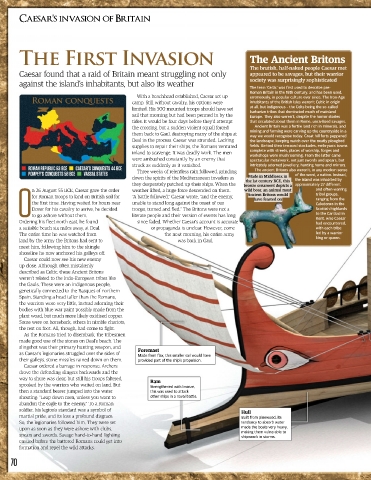
        slingshot was their primary hunting weapon, and   Foremast
        as Caesar’s legionaries struggled over the sides of   Madefromflax,thissmallersailwouldhave
        their galleys, stone missiles rained down on them.   provided part of the ship’s propulsion.
          Caesar ordered a barrage in response. Archers
        drove the defending slingers backwards and the
        way to shore was clear, but still his troops faltered,   Ram
        spooked by the warriors who waited on land. But   Strengthened with bronze,
        then a standard bearer jumped into the water   thiswasusedtoattack
        shouting: “Leap down men, unless you want to   othershipsinanavalbattle.
        abandon the eagle to the enemy.” To a Roman
        soldier, his legion’s standard was a symbol of                                Hull
        martial pride, and its loss a profound disgrace.                              Built from pinewood, its
        So, the legionaries followed him. They were set                               tendency to absorb water
        upon as soon as they were ashore with clubs,                                  made the boats very heavy,
                                                                                      making them vulnerable to
        spears and swords. Savage hand-to-hand fighting                               shipwreck in storms.
        ensued before the battered Romans could get into
        formation and repel the wild attacks.
     70

