


Page 72 - All About History - Issue 28-15
P. 72
Caesar’s invasion of Britain


        The Second Invasion


        Caesar’sfirsttriptoBritainhadbeencostly,buthenowknew
        thathewantedtoconquertheland,forRomeandhimself


             verthewinterof55-54BCE,Caesarbrooded  Before Caesar could capitalise on this rapid
             overhisexpeditiontoBritain.Sure,ithad  progress,he’dagainendupcursingtheBritish
             donehiscelebritystatusnoharm–infactin  weather. Another freak summer storm clattered
             Romenewsofhisexploitssparkeda20-day  its way through the Channel, and when the main
       Oparty–buthewasnotamanusedtofailure.    body of his troops returned, they found most of
        He resolved to return, and this time to conquer.   their ships damaged, with 40 destroyed completely.   personnel carriers in much the same way, and it
          He ordered the construction of a new invasion   Caesar ordered the remaining boats to be   was further proof to the Romans that these Britons
        force with the galleys built to a different spec.   brought ashore. A huge fort was then constructed   were more than mere savages.
        “Made a little shallower than those that are   around them so that they could be repaired in   The battle was bitter, but as good as
        habitually used in the Mediterranean,” as explained   safety. It was a massive undertaking, but it took   Cassivellaunus was, he was no match for Rome’s
        in his campaign diary, “to enable them to be hauled   Caesar’s men just ten days to complete. In that   greatest tactician or the world’s finest war machine.
        up on shore.” He also put together a far bigger army.   time, the British tribes did something they’d never   His forces were eventually overwhelmed and forced
        When he landed near Deal on 7 July 54 BCE, his   done before – they united against a common   to retreat. As he was chased back, he switched
        flotilla of 800 ships disgorged more than 25,000   enemy. They chose as their leader Cassivellaunus,   to guerrilla tactics, destroying food sources and
        legionaries, 2,000 cavalry and a huge baggage train   who ruled the Catuvellauni tribe north of the   laying traps. His army of resistance, however, was
        to supply them. The force was so great that the   Thames. Having recently defeated the Trinovante   crumbling from the inside. As the bodies mounted,
        Britons onshore made no attempt to confront them,   tribe, Cassivellaunus was the best the Britons had.   tribe after tribe joined the Romans, and by the time
        instead retreating to higher ground.   His army met Caesar’s head on at the Stour River.   Caesar crossed the Thames, he knew the location
          Caesar chased them all the way to the Stour   Here, the Romans witnessed first hand one of the   of Cassivellaunus’s secret stronghold.
        River, 12 miles from the coast, and at dawn the   British warriors’ unique tactics. Using lightweight   As Caesar prepared to lay siege to
        following day his troops made their first contact   chariots pulled by two fast ponies, a driver would   Cassivellaunus’s fort at Verulamium, near present-
        with them. After a brief skirmish near present-day   transport a soldier into battle at high speed. From   day St Albans, the British warlord took one last
        Canterbury, the Britons fled to a nearby hill fort,   the back of the chariot he would launch javelins   gamble. He ordered an attack on the Romans’ camp
        which the Romans now attacked.         into the Roman ranks, before dismounting to fight   on the beach near Deal. It was an inspired but
          The fort was ringed by a defensive     at close quarters with a sword or spear. If he   doomed move. When news of its failure reached
        ditch, which the legionaries                     hen tired or found himself becoming   Cassivellaunus, the canny warrior, by now out
        overcame using the ‘tortoise’                    overwhelmed, he could return to the   of options, offered up his surrender. Britannia, it
        formation. By creating an all-                   chariot and be sped away to safety.   seemed, was within Caesar’s greedy grasp. The
        encompassing shield wall,                        A modern army uses armoured   gods however, had other plans.
        they could work in relative
        safety, building a ramp
        across the ditch. The fort’s
        walls were then breached
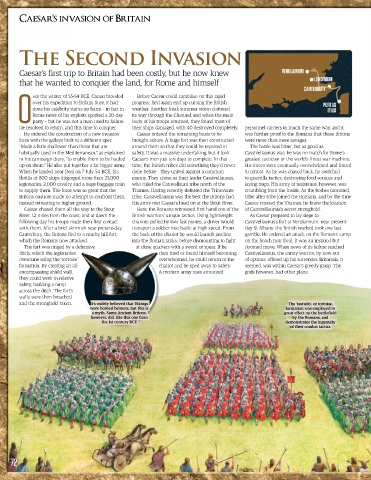
        and the stronghold taken.   It’s widely believed that Vikings                                 The ‘testudo’, or tortoise,
                                 wore horned helmets, but this is                                    formation was employed to
                                 a myth. Some Ancient Britons,                                       great effect on the battlefield
                                 however, did, like this one from                                       by the Romans, and
                                     the 1st century BCE                                             demonstrates the ingenuity
                                                                                                       of their combat tactics


     72

