


Page 82 - All About History - Issue 28-15
P. 82
8P3M%`8B3`*`'J3T5T


        5BOLT


        Until World War I, soldiers were used to being confronted by mounted                      CSJUJTI
        troops on the battlefield. When the first tanks rumbled into action, one                  NBSL *
        German cried: “The Devil is coming!”                                                 Pressure from Winston Churchill
                                                                                            forced the War Office to produce an
                                                                                          armoured bulletproof vehicle; production
                     The advent of the traction   ‘Little Willie’. A second iteration, called ‘Big Willie’   began in 1916. Not everyone was
                     engine and automobile made   then ‘Mother’, followed. They first appeared in   impressed. Field Marshal Douglas
                     tanks possible. Although the   battle at Flers-Courcelette in 1916 and terrified the   Haig said: “The idea that cavalry
                     first self-propelled armoured   Germans. One tank captured a village and another   will be replaced by these iron
       07vehicle was built in 1900 in           a trench of 300 Germans. What the enemy didn’t    coaches is absurd.”
        England for the Boer War, engineers in France,   know, however, was that the first tanks were
        Austria-Hungary, Germany and England were   hopelessly inefficient: the crews were untrained
        dismissed when they proposed tracked armoured   and 17 of the original 49 broke down on the way
        vehicles. In World War I, armoured cars were   to the front; of the remainder, only 21 made it into
        improvised in Belgium, France, and Britain only to   action. It was at the Battle of Cambrai in 1917 that
        prove useless in trenches. The mud was too deep   British tanks achieved their first success, although
        and too thick for them to make any progress and   these versions were too slow, so in 1918 the 14-ton
        they soon became bogged down and immobile.   Medium A appeared with a speed of eight miles
        Having been rejected several times, governments   per hour and a range of 80 miles. The tank
        finally realised they needed vehicles that could   got its name as, without its guns, it looked
        traverse trenches, not get stuck going up hills, cut   like a vehicle for carrying water.
        through barbed wire and provide cover
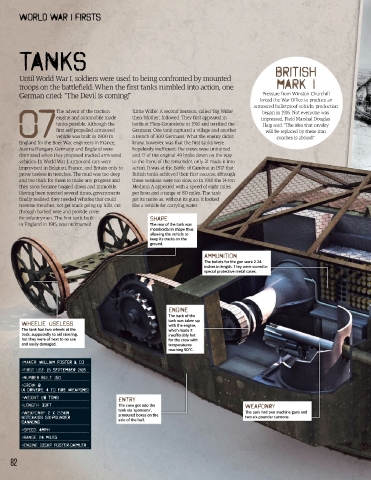
        for infantrymen. The first tank, built        4IBQF
        in England in 1915, was nicknamed             The rear of the tank was
                                                      rhomboidal in shape thus
                                                      allowing the vehicle to
                                                      keep its tracks on the
                                                      ground.

                                                                         "NNVOJUJPO
                                                                         The bullets for the gun were 2.24
                                                                         inches in length. They were stored in
                                                                         special protective metal cases.


                                                            &OHJOF
                                                            The back of the
                                                            tank was taken up
         8IFFMJF  VTFMFTT                                   with the engine,
         The tank had two wheels at the                     which made it
         back, supposedly to aid steering,                  insufferably hot
         but they were of next to no use                    for the crew with
         and easily damaged.                                temperatures
                                                                   º
                                                            reaching 50 C.
          .BLFS   8JMMJBN 'PTUFS   $P

          'JSTU VTF     4FQUFNCFS
          /VNCFS CVJMU
          $SFX
            ESJWFST    UP GJSF XFBQPOT
          8FJHIU     UPOT
                                           &OUSZ
          -FOHUI    GU                     The crew got into the                       8FBQPOSZ
                                           tank via ‘sponsons’,
          8FBQPOSZ    Y     JO             armoured boxes on the                       The tank had two machine guns and
         )PUDILJTT TJY QPVOEFS             side of the hull.                           two six-pounder cannons.
         DBOOPOT
          4QFFE   NQI
          3BOHF     NJMFT
          &OHJOF     IQ 'PTUFS %BJNMFS

