


Page 84 - All About History - Issue 28-15
P. 84
8P3M%`8B3`*`'J3T5T


        &OMJTUFE


        XPNFO


        Women did much more than
        keep the home fires burning.
        Thousands volunteered to serve

                As the men went off to fight, the                                       Joy Bright Hancock served
                                                                                        in World War I and World
                women were left behind. Suffragette                                     War II, becoming one of the
                Emmeline Pankhurst encouraged                                           first female officers in 1942
                women to do more than “nurse
       11soldiers or knit socks.” This led to the
        first government-sponsored organisation, the
        Women’s Forage Corps, followed by the Women’s
        Forestry Corps and the Women’s Land Army. And
        in 1917, the Women’s Army Auxiliary Corps was
        founded. In March, the first 14 WAACS – cooks an
        waitresses – were sent to the front. Despite their
        military service, the women were expected to do
        clerical work, cooking, cleaning and other ‘menial’
        tasks. The corps was disbanded in September 1921.
          In the USA, they began introducing Yeoman
        (F) in the US Naval Reserve during World
        War I. They were usually called Yeowomen or
        Yeomanettes, and the first was Loretta Perfectus
        Walsh. Receiving the same pay as the men, $28.75
        a month, the Yeomanettes, like their British
        equivalents, worked as typists, stenographers,
        accountants, bookkeepers and telephonists. It
        was, as in so many other aspects of this war,
        the technology that allowed the 11,274 recruited
        Yeomanettes to work. Many were stationed in the
        nation’s capital, although Yeomen (F) served in
        England, France, Puerto Rico, the Virgin Islands,
        the Canal Zone, Guam and the Territory of Hawaii.
        The first black women to serve in the US Navy
        were 16 Yeomanettes from some of ‘Washington’s
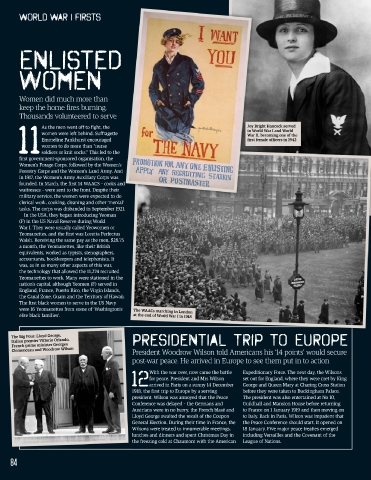
                                                The WAACs marching in London
        elite black families’.                  at the end of World War I in 1918


     The Big Four: Lloyd George,
     Italian premier Vittorio Orlando,         1SFTJEFOUJBM USJQ UP &VSPQF
     French prime minister Georges
     Clemenceau and Woodrow Wilson             President Woodrow Wilson told Americans his ‘14 points’ would secure
                                               post-war peace. He arrived in Europe to see them put in to action

                                                      With the war over, now came the battle   Expeditionary Force. The next day, the Wilsons
                                                      for peace. President and Mrs Wilson   set out for England, where they were met by King
                                               12  arrived in Paris on a sunny 14 December   George and Queen Mary at Charing Cross Station
                                               1918, the first trip to Europe by a serving   before they were taken to Buckingham Palace.
                                               president. Wilson was annoyed that the Peace   The president was also entertained at No 10,
                                               Conference was delayed – the Germans and   Guildhall and Mansion House before returning
                                               Austrians were in no hurry, the French blasé and   to France on 1 January 1919 and then moving on
                                               Lloyd George awaited the result of the Coupon   to Italy. Back in Paris, Wilson was impatient that
                                               General Election. During their time in France, the   the Peace Conference should start. It opened on
                                               Wilsons were treated to innumerable meetings,   18 January. Five major peace treaties emerged
                                               lunches and dinners and spent Christmas Day in   including Versailles and the Covenant of the
                                               the freezing cold at Chaumont with the American   League of Nations.


     84

