


Page 9 - (DK Eyewitness) Travel Guide - Mallorca, Menorca & Ibiza
P. 9
HOW T O USE THIS GUIDE 7
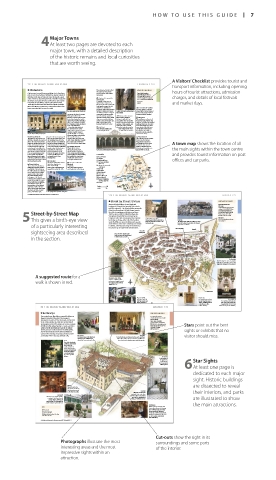
Major Towns
4At least two pages are devoted to each
major town, with a detailed description
of the historic remains and local curiosities
that are worth seeing.
A Visitors’ Checklist provides tourist and
112 THE BALEARIC ISLANDS AREA B Y AREA CIUT ADELLA 113
transport information, including opening
y Ciutadella Their distinctive façades reflect VISITORS’ CHECKLIST
the character of the town’s hours of tourist attractions, admission
A picturesque town with narrow, winding streets, handsome noble mansions built during Practical Information
palaces and a busy harbour, Ciutadella has always competed that period. Town Hall, Plaça des Born 15.
with Maó. In the days of Arab rule it was the island’s capital, E Claustre de Convent de * 29,000. Tel 971 484 155. charges, and details of local festivals
( Fri & Sat. _ Festa Sant Joan
and in 1558 it was invaded by the Turks, who killed many of its Sant Agustí (23–24 Jun). ∑ ajciutadella.org
inhabitants and carted off some 3,500 more to slave markets C/ Seminari 7. Tel 971 481 297. Transport
in Istanbul. Of its buildings, only the cathedral remained. Open 10:30am–1:30pm Tue–Sat. @ g and market days.
Those who survived were determined to rebuild Ciutadella. The museum at the Convent de
Most of the Menorcan aristocracy continued to make it their Sant Agustí occupies the old
home, even after Maó became the capital. cloisters. Its collection of object of a folk cult. Standing
prehistoric and modern artifacts
near the chapel is a column
Neo-Gothic canopy above the Cathedral altar includes a miniature statuette Ses Voltes’ arches line the walkway leading topped with a bronze figure of
the Lamb of God, the work of
of a bull and a bronze casting of
to the Cathedral
century on the site of a mosque. a mermaid. It also has a collec- local artist Matias Quetglas.
Although it suffered fire tion of Catalonian paintings, of Menorcan aristocrat, Joan
damage, it escaped much of the and some sacred objects made Miquel Saura, stands the P Plaça Nova
destruction during the Turkish of precious metals, including Baroque Capella del Sant This small square is the site of
raid but was heavily remodelled chalices and Communion cups. Crist, built in 1667. Its fanciful the town’s most popular cafés
after 1558. During the Civil War Next to the cloisters is the façade is decorated with stone and bars. Ses Voltes, an arcarded
the Republican militia destroyed Baroque Església de Socors. carvings of fruit garlands and walkway which runs from here
most of its furnishings. masks. The statue of Christ to the cathedral, is one of the
One of the oldest parts of R Sant Crist above the high altar is said to main streets of the Old Town.
the cathedral is the Gothic Near the bank building that have dripped with sweat The Moorish vaulted arches
south entrance that bears stone was formerly the house in 1661 and became the that line the street hide a
and the heraldic crests of the
and souvenir shops.
Plaça d’es Born, the town’s principal square carvings of weird creatures good selection of patisseries
Menorcan knights and nobility.
Exploring Ciutadella façades. The most imposing of The main Neo-Classical P Plaça Llibertat
Though there are few traces of these are the Palau Salort and entrance dates from the early This charming square situated
Arab rule, Ciutadella has much to the adjoining Palau de Torre- 1800s. Inside, light filters through at the rear of the former
offer in the way of architecture. Saura. The latter is embellished the stained-glass window to Augustinian monastery is
Numerous opulent palaces and by two handsome loggias and bathe the nave in a gentle glow. well known to all who shop A town map shows the location of all
Gothic and Baroque churches its frontage proclaims the family for food. Its two covered
reveal just how successful the coat of arms above a forbidding P Església del Roser markets, selling fresh meat,
restoration of Ciutadella in the wooden door that leads into a C/ Roser. Tel 971 383 563. fish, fruit and vegetables, are the main sights within the town centre
17th and 18th centuries was. The courtyard. The aristocratic The façade of this small Arcades of the covered market in Plaça Llibertat popular with the locals.
main square in town is Plaça d’es interior is, however, out of church includes a beautiful
Born, a characterful area close bounds. The square also holds 17th-century Spanish Baroque- and provides tourist information on post
to the Gothic cathedral. The several appealing bars and style doorway. Destroyed during Ciutadella
Museu Municipal holds a wide restaurants, perfect for a the Civil War, the church was 1 Plaça d’es Born Museu Municipal
collection of prehistoric artifacts relaxing break. rebuilt and is now used as a 2 Catedral
gathered from all over the island municipal exhibition hall. 3 Església del Roser Santa Clara offices and car parks.
and is well worth a visit. R Cathedral P Can Saura and Palau 4 Can Saura and Palau PORTAL DE SA FONT AVDA. DE LA CONSTITUCIÓ
Plaça de la Catedral. Tel 971 356 523.
P Plaça d’es Born Open 10am–4pm Mon–Fri, Martorell Martorell PLAÇA C. DEL DORMIDOR
DE LES MONGES
This is a former Arab military 10am–2:15pm Sat. & C/ Santissim. 5 Claustre de Convent de SANT JOAN C. DE SANT MI QUEL
drill ground and was rebuilt in Work on the cathedral began These two adjacent palaces Sant Agustí CALLE DE S ANT CRISTOFOL Plaça d’es Tudons Naveta
a grand Neo-Classical style in towards the end of the 13th were built in the 17th century. 6 Sant Crist C. DE SA MURADETA C. DE SANTA CLARA Nova Plaça Alfons III Plaça Alfons Iii
the 19th century. It is said to be 7 Plaça Nova C. DE MAÓ
one of Spain’s most beautiful 8 Plaça Llibertat C. D. SAN T SEBASTIÁ C. DE J.M. QUADRADO Sant Crist C. DE SANT Bus
squares. At its centre stands 9 Santa Clara Catedral Llibertat Plaça ELOI Terminal
an obelisk marking Any de 0 Museu Municipal Punta na Mari Torre-Saura C. MAJOR D’ÉS BORN C.D.ESEMINARI La Ermita de Sant Joan
Palau de
la Desgràcia – the “Year of q Plaça Alfons III Harbour PLAÇA Església del Roser Claustre de Convent de Missa
Calamity”, when Turkish corsairs w Plaça de s’Esplanada D'ES BORN Palau de Sant Agustí
invaded Ciutadella. The square and Plaça dels Pins Ajuntament Salort Can Saura &
is lined with historic buildings, e Harbour Palau Martorell
including the town hall, a PLAÇA AVDA. JAUME I
former palace of the Moorish 0 metres 200 Castell de BEN C. DEL NOU JULIOL C.D.ST PERE D'ALCÁNT ARA SANT ISIDRE
governor, as well as the late Sant Nicolau S’ESPLANADA EJAMI VIVES C.DE M. JOAN PURISSIMA C. DE LA
19th-century Teatre Municipal 0 yards 200 DELS PINS PLAÇA
d’es Born and 19th-century AVDA. DEL CAPIT À NEGRET E
palaces with Italian-style Cafés spilling onto the pavements at Plaça Nova CALA BLANCA
For hotels and restaurants in this region see pp150–51 and pp159–61 For keys to symbols see back flap
120 THE BALEARIC ISLANDS AREA B Y AREA EIVISSA 121
1 Street by Street: Eivissa VISITORS’ CHECKLIST
Attracted by the hilltop site and sheltered Practical Information
* 49,500.
harbour, the Phoenicians founded Eivissa in the
mid-7th century BC. The Puig de Molins necropolis Tel 902 404 704. n Passeig Vara
de Rey, 1, 971 301 900. ( Mon–
dates from those days. Dalt Vila (Upper Town) is
Street-by-Street Map the oldest remaining part of Eivissa and since Sat (summer). _ Sant Joan
(23 Jun), Sant Cristòbal (10 Jul),
1999 has been a UNESCO World Heritage site.
Nostra Senyora de les Neus
(8 Aug), Sant Ciriac (5 Aug).
5This gives a bird’s-eye view Strengthened by fortifications begun by the . Portal de ses Taules Dalt Vila Transport
Emperor Charles V, it once guarded the entrance
k Es Codolar, 8 km (5 miles) to
A broad paved drive leads from Sa
to the bay. Sa Penya, at the end of the harbour
the southwest.
The Upper Town, built on a hill, is best seen
under Dalt Vila, was once the fishermen’s quarter
Penya to Portal de ses Taules – the
from the harbour shore where its strategic
main town gate.
of a particularly interesting and is still one of the more colourful parts of town. Museu Arqueològic City walls
importance is obvious.
La Marina, stretching out along the waterfront, is
the place to go for night-time entertainment.
sightseeing area described Plaça del Sol’s shady square Contemporani S A C A R R O S S A
Museu d’Art
looks out over the harbour and
in the section. is full of shops and cafés.
R O S A R I S A N T C A R L E S I G N A S I R I Q U E R G . B A L A N S A T
P E R E T U R
S A N T J O S E P J O A N R O M A N C A R R E R D E P O N E N T
C O N Q U I S T A Quiet by day, Sa Carrossa is popular
Sa Carrossa
with Eivissa’s gay visitors and is a hip
P L AÇ A D E L A night-time hangout in the summer.
C AT E D R A L
A suggested route for a Capella de Sant Ciriac R O N D A D E J O A N B A P T I S T A C A L V I
walk is shown in red. A mass is celebrated here
each year in August to mark
the capture of the town by
Jaume I in 1235.
Castell Almudaina
Plaça de la Vila Reial Curia
The main square of The modest house of the . Cathedral
Dalt Vila is lined with former Royal Tribunal of The cathedral, dedicated to
shops, restaurants Key Justice, standing near the Our Lady of the Snows, was
and cafés to tempt cathedral, has a fine completed in 1592. It is Dalt
passing visitors. Suggested route Gothic doorway. Vila’s most impressive building.
68 THE BALEARIC ISLANDS AREA B Y AREA M ALL ORC A 69
For hotels and restaurants in this region see p151 and pp161–3
0 La Granja VISITORS’ CHECKLIST
This country house (finca) lies in a wooded valley, near Practical Information
Esporles. From the 13th to the 15th centuries it 2 km (1 mile) west from Esporles.
belonged to an order of Cistercian monks, and after this Tel 971 610 032.
Open 10am–7pm daily
to the Fortuny family. The estate has survived almost (summer), 10am–6pm (winter).
unchanged since the 18th century and is now a museum 0 & Art & craft exhibition and Stars point out the best
of folklore, full of antique furniture, ceramics and other horse dressage shows: Feb–Oct
artifacts. Mouth-watering hams hang in the antique Wed & Fri 3–4:20pm.
∑ lagranja.net
kitchen, peacocks stroll around the beautiful garden, sights or exhibits that no
and the local restaurant serves delicious Mallorcan
cuisine. In the mornings it is quieter, and you can still
see displays of horse dressage and local crafts. Dye-house . Salon visitor should miss.
This formed part of the domestic The formal rooms are situated on the north side. Next
quarters, most of which were to the salon are the games room and a small theatre.
situated in basements and cellars.
Park From here, French windows open onto the garden.
The estate, situated in
a valley, is surrounded
by a park to the
south and west. Its
landscaping includes
streams and waterfalls;
the house is almost
completely hidden
by a dense growth
of trees. . Garden
At the centre of
the garden is a Star Sights
small fountain;
the escarpment
6At least one page is
hides a grotto.
dedicated to each major
sight. Historic buildings
Library are dissected to reveal
Situated next to the
Renaissance bedroom,
the library also served Corridor
as the master’s study. Windows overlook the their interiors, and parks
Courtyard courtyard. On its east side is
The house is arranged around a a row of smaller rooms, where
you can see, among other
courtyard. Don’t miss the old things, an exhibition of toys. are illustrated to show
carriage that is parked in an
open garage. The courtyard has
a wide entrance gate to the east.
Exhibitions the main attractions.
KEY Visitors can see an equest-rian
show with professionals training
1 Restaurant horses (Wednesday and Friday
2 Gate to the park afternoons from February to
October), as well as local artisans
3 Main entrance, where the shop working in traditional crafts such
and café are located. as shoe-making, basketwork
and embroidery.
For hotels and restaurants in this region see pp148–50 and pp155–9
Cut-outs show the sight in its
Photographs illustrate the most surroundings and some parts
interesting areas and the most of the interior.
impressive sights within an
attraction.
006-007_EW_Mallorca.indd 7 09/10/17 10:29 am

