


Page 133 - (DK Eyewitness) Travel Guide - England's South Coast
P. 133
DORSE T AND SOMERSE T 131
to showcase US arts and crafts
and promote Anglo-American Richard “Beau” Nash
understanding. The rooms in the (1674–1762)
1820 manor house are decorated Elected in 1704 as Master of Ceremonies,
in many different styles, from “Beau” Nash played a crucial role in
the rudimentary dwellings of transforming Bath into a fashionable
the first settlers to the opulent centre of Georgian society. During his
style of 19th-century homes. The career, he devised an endless selection
museum has special sections on of games, balls and entertainment
Shaker furniture, quilts and Native (including gambling), which kept
American art, and a replica of the idle rich amused and ensured
George Washington’s Mount Portrait of Richard “Beau” Nash a constant flow of visitors.
Vernon garden of 1785.
The Great Bath VISITORS’ CHECKLIST
According to legend, Bath owes its origin to the Celtic Practical Information
King Bladud, who discovered the curative properties of Entrance in Abbey Churchyard.
its natural hot springs in 860 BC. In the 1st century, the Tel 01225 477785. Open 9:30am–
Romans built baths and a temple around the therapeutic 5pm daily (Jul & Aug: to 9pm).
Closed 25 & 26 Dec. & 7
waters. Bath Abbey’s medieval monks also later exploited limited. - ∑ romanbaths.co.uk
the spring’s properties, and Bath became a fashionable
hub of high society after Queen Anne bathed here in
1702–3. Work began on the present structure in the 18th
century, and further building work in the 19th-century
revealed the remains of the Roman Bath chambers.
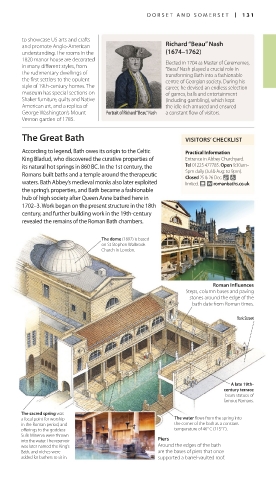
The dome (1897) is based
on St Stephen Walbrook
Church in London.
Roman Influences
Steps, column bases and paving
stones around the edge of the
bath date from Roman times.
York Street
A late 19th-
century terrace
bears statues of
famous Romans.
The sacred spring was
a focal point for worship The water flows from the spring into
in the Roman period, and the corner of the bath at a constant
offerings to the goddess temperature of 46° C (115° F).
Sulis Minerva were thrown
into the water. The reservoir Piers
was later named the King’s Around the edges of the bath
Bath, and niches were are the bases of piers that once
added for bathers to sit in. supported a barrel-vaulted roof.
130-131_EW_ESC.indd 131 10/03/17 6:54 pm

