


Page 135 - (DK Eyewitness) Travel Guide - England's South Coast
P. 135
DE VON 133
DEVON
A county of lush pasture divided into a patchwork
of tiny fields, Devon is threaded with narrow lanes
whose banks support a mass of wildflowers,
from the primroses of early spring to summer’s
colourful tangle of foxglove and cornflower. On its coastline are dramatic
beetling cliffs and long sandy beaches, along with some of the country’s
most famous seaside resorts. Historic cities, idyllic villages, sheltered rivers,
bustling ports and the vast moors of Dartmoor only add to the mix.
Prehistoric Devon may have had a warmer Plymouth was also the point of arrival for
climate than much of Britain, and it is the the first exotic imports from the Americas,
earliest known place in England to have including spices, wine, corn, potatoes and
been settled after the end of the last Ice tobacco. Devon’s central role during the
Age – a jawbone discovered at Kents Age of Discovery also left it with some
Cavern, near Torquay, is thought to belong remarkable Tudor houses and villages.
to the earliest modern human in northwest Devon became an important destination
Europe. By 6000 BC, Dartmoor seems to again during the Victorian era, as new train
have played a key role in Mesolithic and lines and a vogue for sea air and swimming
Neolithic culture – the bleak moorland saw the development of many seaside
holds the remains of the oldest surviving towns. Most famous were the resort towns
buildings in the country, although this on the South Coast – Torquay, Paignton and
could be because the moor was infertile Brixham – which became known as the
and never ploughed. English Riviera for their relatively balmy
Only a few parts of Devon fell under climate, subtropical vegetation and palm-
Roman rule, and the county continued to lined promenades. These towns continue
play a marginal role in history until Tudor to draw the crowds, and today tourism has
times, when the natural harbour at overtaken agriculture as Devon’s main
Plymouth became the point of departure source of income, but the two traditions
for explorers and adventurers such as still unite in the county’s most famous
Sir Walter Raleigh and Sir Francis Drake. delicacy – the Devonshire Cream Tea.
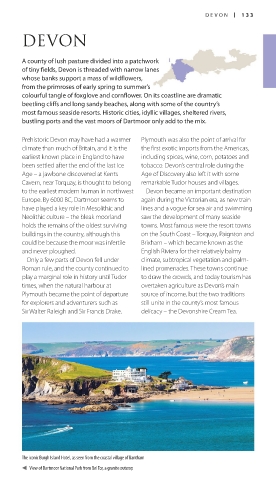
The iconic Burgh Island Hotel, as seen from the coastal village of Bantham
View of Dartmoor National Park from Bel Tor, a granite outcrop
132-133_EW_ESC.indd 133 10/03/17 6:54 pm

