


Page 146 - (DK Eyewitness) Travel Guide - England's South Coast
P. 146
144 ENGLAND ’ S SOUTH C O AST REGION B Y REGION
r Plymouth
Sir Francis Drake (c.1540–96)
Plymouth. Map C6. * 255,000.
3 @ g n 3–5 The Barbican; Sir Francis Drake was the first Englishman to circumnavigate the
01752 306330. ( Mon–Sat. globe for which he was knighted by Elizabeth I in 1580. Four years
∑ visitplymouth.co.uk later he introduced tobacco and potatoes to England, after bringing
home 190 colonists who had tried to
The most iconic of all English establish a settlement in Virginia. To
ports, Plymouth is the place many, however, Drake was no more
from which several explorers, than an opportunistic rogue, renowned
discoverers and adventurers, for his exploits as a “privateer”, the polite
including Sir Francis Drake, Sir name for a pirate. Catholic Spain was
Walter Raleigh, James Cook and England's bitter rival for supremacy on
the Pilgrim Fathers, set sail and the seas and Drake further endeared
changed the history of the world. himself to the queen and the people
The city was heavily bombed by his part in the famous victory over
during World War II, and its King Philip II’s Armada (see p36), which
Victorian centre was almost was defeated by bad weather and the
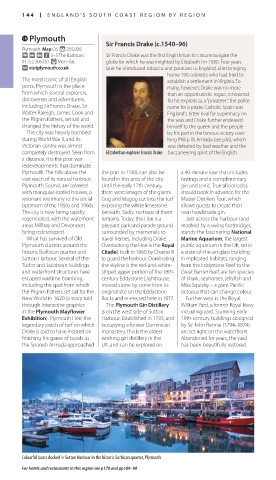
completely destroyed. Seen from Elizabethan explorer Francis Drake buccaneering spirit of the English.
a distance, it is the post-war
redevelopments that dominate
Plymouth. The hills above the the port in 1588, can also be a 40-minute tour that includes
vast reach of its natural harbour, found in this area of the city. tastings and a complimentary
Plymouth Sound, are covered Until the early 17th century, gin and tonic. True aficionados
with triangular-roofed houses, a there were images of the giants should book in advance for the
resonant testimony to the social Gog and Magog cut into the turf Master Distillers Tour, which
optimism of the 1950s and 1960s. exposing the white limestone allows guests to create their
The city is now being rapidly beneath. Sadly, no trace of them own handmade gin.
regenerated, with the waterfront remains. Today, the Hoe is a Just across the harbour (and
areas Millbay and Devonport pleasant park and parade ground reached by a swing footbridge),
being redeveloped. surrounded by memorials to stands the fascinating National
What has survived of Old naval heroes, including Drake. Marine Aquarium, the largest
Plymouth clusters around the Overlooking the Hoe is the Royal public aquarium in the UK, set in
historic Barbican quarter and Citadel, built in 1660 by Charles II a state-of-the-art glass building.
Sutton Harbour. Several of the to guard the harbour. Dominating In replicated habitats, ranging
Tudor and Jacobean buildings the skyline is the red-and-white- from the Eddystone Reef to the
and waterfront structures here striped upper portion of the 18th- Great Barrier Reef, are ten species
escaped wartime bombing, century Eddystone Lighthouse, of shark, seahorses, jellyfish and
including the spot from which moved stone by stone from its Miss Squishy – a giant Pacific
the Pilgrim Fathers set sail for the original site on the Eddystone octopus that can change colour.
New World in 1620 (a story told Rocks and re-erected here in 1877. Further west is the Royal
through interactive graphics The Plymouth Gin Distillery William Yard, a former Royal Navy
at the Plymouth Mayflower is on the west side of Sutton victualing yard. Stunning early
Exhibition). Plymouth Hoe, the Harbour. Established in 1793, and 19th-century buildings designed
legendary patch of turf on which occupying a former Dominican by Sir John Rennie (1794–1874)
Drake is said to have insisted on monastery, this is the oldest are set right on the waterfront.
finishing his game of bowls as working gin distillery in the Abandoned for years, the yard
the Spanish Armada approached UK, and can be explored on has been beautifully restored
Colourful boats docked in Sutton Harbour in the historic Barbican quarter, Plymouth
For hotels and restaurants in this region see p178 and pp189–90
144-145_EW_ESC.indd 144 10/03/17 6:54 pm

