


Page 60 - World of Animals - Issue #31
P. 60
Conserving dolphins

            Flipper’s family


            These diverse marine mammals range from the
            tiny Maui’s dolphin to the mighty orca
            It’s easy to picture a dolphin in our minds.   dolphins swim upside down to spot predators   dolphins in the estuaries of America have also
            Smooth grey skin, a long snout and a happy   swimming above them. Every species has   learned this trick and force themselves up

            smile. The species you’re thinking of is the   evolved unique anatomy and behaviours that   riverbanks after driving fish towards the mud.
            bottlenose, made famous by the television   equip them with the tools they need to survive.   They’ve even figured out that the gritty silt can

            show Flipper and found in aquariums across   Having blossomed from paddling carnivores   wear down their teeth, so the dolphins always
            the planet. These instantly recognisable animals   into a diverse group of skilled ocean predators,   land on the same side of their bodies to keep at
            represent only one of over 40 dolphin species,   these toothed whales have truly earned their   least half of their teeth safe from erosion.
            many of which face severe threats. Whether   place on Earth.                   This kind of behaviour is seen in small
            they inhabit deep oceans, river estuaries   No species tells this story better than   populations of animals, and is passed down
            or shallow seas, each species has its own   the largest dolphin – the orca. Despite also   through generations and even shared between
            challenges, but many of their lives are seriously   being called the killer whale, this animal is in   friends. It isn’t evolved behaviour, it’s learned
            impacted by human activity.            the dolphin family and sits at the very top   and remembered just like early humans
              Each species has evolved to fill a specific   of the oceanic food chain. These animals   developing methods for hunting and creating


            niche, like the striped dolphin that scours the   have developed group hunting techniques   fire. These are animals that are smart enough


            surface of open ocean for fish. The Ganges river   to rival any land animal, and even join the   to make traditions, and should be protected by
            dolphin has adapted to live in murky water by   terrestrial hunters to catch sea lions on land by   humans from the man-made dangers that the
            completely losing its sight, and Commerson’s   purposefully beaching themselves. Bottlenose   oceans now hold.
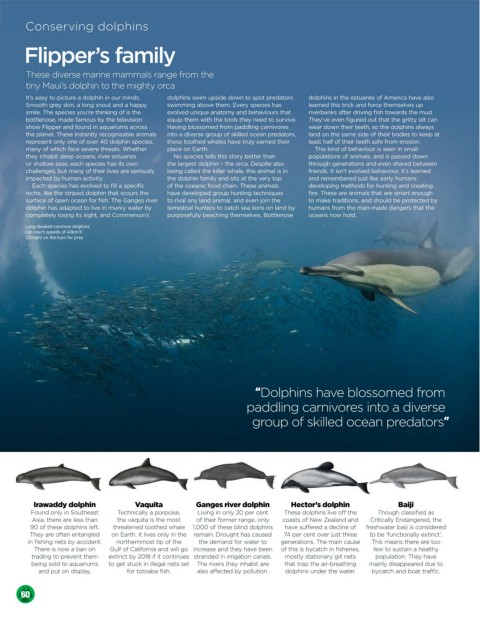
            Long-beaked common dolphins
            can reach speeds of 40km/h
            (25mph) on the hunt for prey


                                                                           “Dolphins have blossomed from
                                                                        paddling carnivores into a diverse

                                                                          group of skilled ocean predators”


              Irawaddy dolphin            Vaquita         Ganges river dolphin      Hector’s dolphin             Baiji

             Found only in Southeast   Technically a porpoise,   Living in only 20 per cent   These dolphins live off the   Though classified as
              Asia, there are less than   the vaquita is the most   of their former range, only   coasts of New Zealand and   Critically Endangered, the
             90 of these dolphins left.   threatened toothed whale   1,000 of these blind dolphins   have suffered a decline of   freshwater baiji is considered
             They are often entangled   on Earth. It lives only in the  remain. Drought has caused   74 per cent over just three   to be ‘functionally extinct’.

             in fishing nets by accident.   northernmost tip of the   the demand for water to   generations. The main cause   This means there are too

              There is now a ban on   Gulf of California and will go  increase and they have been   of this is bycatch in fisheries,   few to sustain a healthy
              trading to prevent them   extinct by 2018 if it continues  stranded in irrigation canals.   mostly stationary gill nets   population. They have
              being sold to aquariums   to get stuck in illegal nets set  The rivers they inhabit are   that trap the air-breathing   mainly disappeared due to


                and put on display.     for totoaba fish.   also affected by pollution.  dolphins under the water.  bycatch and boat traffic.
           60


       058-062_Conserving_the_dolphin_WOA31.indd   60                                                                        02/03/2016   16:00

