


Page 57 - World of Animals - Issue #31
P. 57
The not-so-lazy sloth


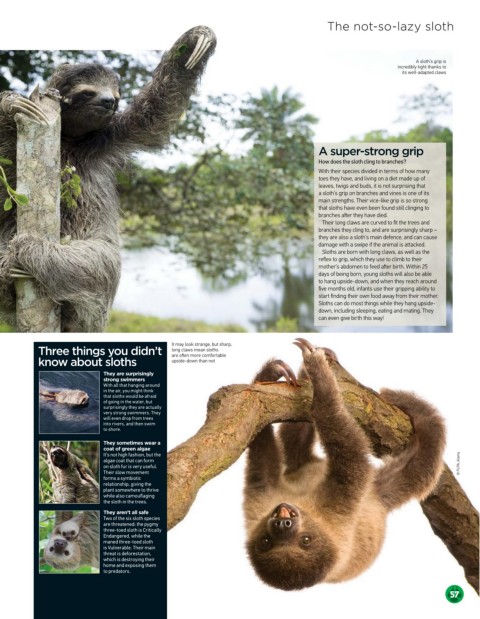
                                                                                                                      A sloth’s grip is
                                                                                                                 incredibly tight thanks to
                                                                                                                   its well-adapted claws


                                                                                            A super-strong grip
                                                                                            How does the sloth cling to branches?
                                                                                            With their species divided in terms of how many
                                                                                            toes they have, and living on a diet made up of
                                                                                            leaves, twigs and buds, it is not surprising that
                                                                                            a sloth’s grip on branches and vines is one of its
                                                                                            main strengths. Their vice-like grip is so strong
                                                                                            that sloths have even been found still clinging to

                                                                                            branches a er they have died.
                                                                                             Their long claws are curved to fit the trees and

                                                                                            branches they cling to, and are surprisingly sharp –
                                                                                            they are also a sloth’s main defence, and can cause
                                                                                            damage with a swipe if the animal is attacked.
                                                                                             Sloths are born with long claws, as well as the

                                                                                            reflex to grip, which they use to climb to their
                                                                                            mother’s abdomen to feed a er birth. Within 25

                                                                                            days of being born, young sloths will also be able
                                                                                            to hang upside-down, and when they reach around

                                                                                            five months old, infants use their gripping ability to
                                                                                            start finding their own food away from their mother.

                                                                                            Sloths can do most things while they hang upside-
                                                                                            down, including sleeping, eating and mating. They
                                                                                            can even give birth this way!

               Three things you didn’t              It may look strange, but sharp,
                                                    long claws mean sloths

                                                    are o en more comfortable
               know about sloths                    upside-down than not
                                 They are surprisingly
                                 strong swimmers
                                 With all that hanging around
                                 in the air, you might think
                                 that sloths would be afraid
                                 of going in the water, but
                                 surprisingly they are actually
                                 very strong swimmers. They
                                 will even drop from trees
                                 into rivers, and then swim
                                 to shore.
                                 They sometimes wear a
                                 coat of green algae
                                 It’s not high fashion, but the
                                 algae coat that can form
                                 on sloth fur is very useful.                                                                     © FLPA, Alamy
                                 Their slow movement
                                 forms a symbiotic
                                 relationship, giving the
                                 plant somewhere to thrive
                                 while also camouflaging

                                 the sloth in the trees.
                                 They aren’t all safe
                                 Two of the six sloth species
                                 are threatened: the pygmy
                                 three-toed sloth is Critically
                                 Endangered, while the
                                 maned three-toed sloth
                                 is Vulnerable. Their main
                                 threat is deforestation,
                                 which is destroying their
                                 home and exposing them
                                 to predators.

                                                                                                                               57


       054-057_WOA31_Sloths.indd   57                                                                                        02/03/2016   15:14

