


Page 136 - (DK Eyewitness) Travel Guide - Sicily
P. 136
134 SICIL Y AREA B Y AREA
Piazza Armerina: Villa del Casale
This famous villa was part of a 3rd–4th century AD estate, and is one of the most
fascinating attractions in archaeologically rich Sicily. The exceptionally beautiful
mosaics that decorated every one of the rooms of the landowner’s apartments have
been preserved through the centuries, thanks to a flood that buried them in mud
in the 12th century. The villa was discovered in the late 19th century. A logical
sequence for a visit to the site is as follows: the thermae, the large peristyle, the
long corridor with hunting scenes, and lastly the owners’ private apartments.
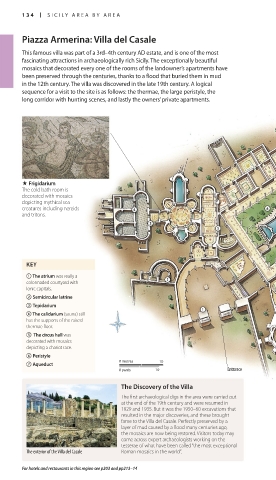
. Frigidarium
The cold bath room is
decorated with mosaics
depicting mythical sea
creatures including nereids
and tritons.
KEY
1 The atrium was really a
colonnaded courtyard with
Ionic capitals.
2 Semicircular latrine
3 Tepidarium
4 The calidarium (sauna) still
has the supports of the raised
thermae floor.
5 The circus hall was
decorated with mosaics
depicting a chariot race.
6 Peristyle
0 metres 10
7 Aqueduct
0 yards 10 Entrance
The Discovery of the Villa
The first archaeological digs in the area were carried out
at the end of the 19th century and were resumed in
1929 and 1935. But it was the 1950–60 excavations that
resulted in the major discoveries, and these brought
fame to the Villa del Casale. Perfectly preserved by a
layer of mud caused by a flood many centuries ago,
the mosaics are now being restored. Visitors today may
come across expert archaeologists working on the
tesserae of what have been called “the most exceptional
The exterior of the Villa del Casale Roman mosaics in the world”.
For hotels and restaurants in this region see p203 and pp213–14
134-135_EW_Sicily.indd 134 11/3/16 2:07 PM

