


Page 139 - (DK Eyewitness) Travel Guide - Sicily
P. 139
SICIL Y AREA B Y AREA 137
SOUTHERN SICILY
Dominated by Mount Etna, southern Sicily’s
permanent backdrop, this area is a curious
mixture of fertile land and intensive cultivation,
ancient monuments and utter neglect. Many
towns and monuments built by the ancient
Greeks still survive, most notably in the town
of Syracuse, birthplace of Archimedes.
Southern Sicily, which the Arabs called Inland, the rebuilding of towns following
the Val di Noto, presents another facet the earthquake of 1693 resulted in
of the region. It is very different from the a number of Baroque gems. The
western end of the island, although the churches, buildings and balconies of
topography is equally varied. The west Ragusa, Modica, Scicli, Noto and
has Phoenician Palermo, while the south Chiaramonte are a triumph of the Sicilian
has Greek Syracuse. One of Sicily’s most Baroque style, with their majestic steps,
important sights is the stony-tiered detailed ornamentation and curving
Greek theatre in Syracuse. The tradition façades. Ibla, the medieval quarter of
of performing ancient Greek plays was Ragusa, should be included on a tour
revived in 1914, and now every summer of the towns of the interior; rocky
the great works of the ancient tragedians Caltagirone is an important ceramics
come to life in their natural setting. This centre, and Chiaramonte and Vizzini also
part of Sicily is also home to the ancient have their charms. In complete contrast
Greek ruins of Megara Hyblaea, now you can also experience the natural
sadly dominated by the landscape of silence of the rock-cut necropolises
the refineries of Augusta. in the cliffs of Ispica and Pantalica.
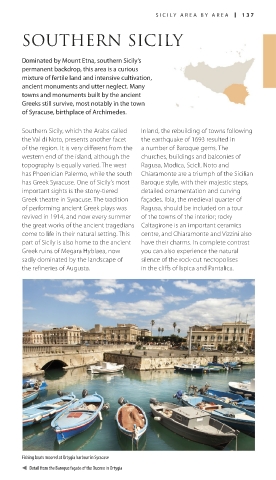
Fishing boats moored at Ortygia harbour in Syracuse
Detail from the Baroque façade of the Duomo in Ortygia
136-137_EW_Sicily.indd 137 11/3/16 2:07 PM

